Insights
Demand Sensing vs. Demand Forecasting: Understanding the Next Evolution
Executive Summary
Accurate demand planning has always been a cornerstone of effective supply chain management. Traditionally, organizations have relied on demand forecasting, using historical sales data and market trends to predict future demand. While this approach remains essential for long-term planning, today's rapidly changing markets require businesses to respond faster than historical models alone can support.
Demand sensing has emerged as the next evolution in demand planning. By combining real-time operational data with Artificial Intelligence (AI) and advanced analytics, organizations can detect changing demand patterns early and make faster, more informed decisions. Companies that successfully integrate demand forecasting with demand sensing improve forecast accuracy, optimize inventory, reduce costs, and strengthen customer service.
Introduction
Consumer demand is more unpredictable than ever. Promotions, weather events, economic conditions, social media trends, and competitor activities can influence purchasing behavior within hours rather than weeks.
Traditional forecasting methods often struggle to capture these rapid shifts because they primarily rely on historical data. As a result, organizations may experience inventory shortages, excess stock, or production plans that no longer reflect actual market conditions.
Demand sensing addresses this challenge by incorporating live operational signals into short-term planning, allowing businesses to respond more quickly to changing customer demand.
Understanding the Difference
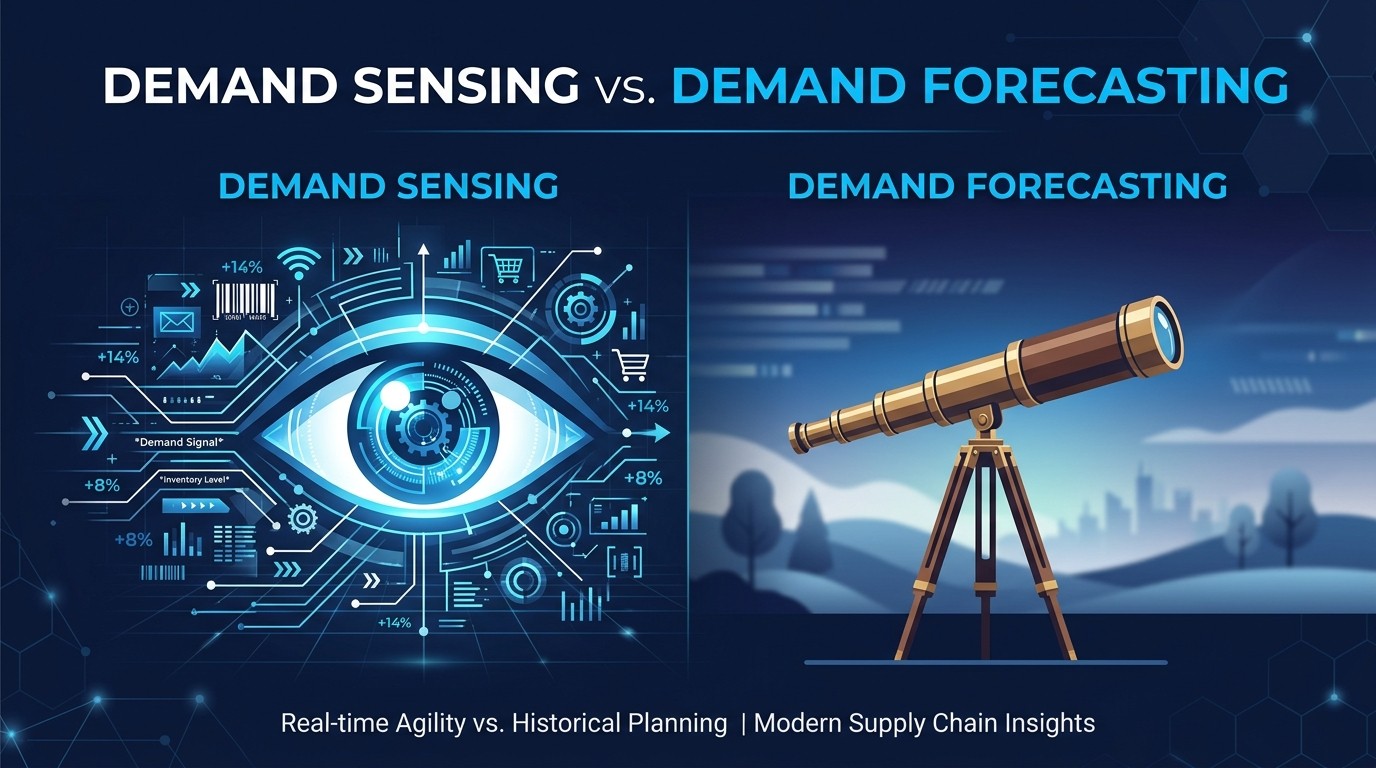
Although often discussed together, demand forecasting and demand sensing serve different business purposes.
Demand Forecasting
Demand forecasting estimates future demand using historical information and statistical analysis.
Common inputs include:
Historical sales data
Seasonal demand patterns
Promotional calendars
Market trends
Economic indicators
Product life cycle information
Forecasting supports medium- and long-term decisions such as procurement, production capacity, budgeting, and workforce planning. It performs best in relatively stable business environments where historical trends remain reliable.
Demand Sensing
Demand sensing complements forecasting by analyzing near real-time operational data to improve short-term planning.
Instead of relying primarily on historical information, it evaluates signals such as:
Point-of-sale transactions
E-commerce activity
Distributor inventory levels
Retail replenishment data
Weather forecasts
Local events
Social media activity
Online search behavior
Transportation disruptions
AI and machine learning continuously interpret these signals to recommend inventory and replenishment adjustments before demand changes become visible through traditional forecasting.
Demand Forecasting vs. Demand Sensing
The two approaches are complementary rather than competitive.
Demand Forecasting | Demand Sensing |
Based primarily on historical data | Uses real-time operational signals |
Supports strategic planning | Supports operational decision-making |
Updated periodically | Continuously refined |
Focuses on long-term demand trends | Responds to immediate market changes |
Guides procurement and capacity planning | Optimizes inventory and replenishment |
Organizations achieve the greatest value by combining both approaches rather than replacing one with the other.
Business Benefits
Demand sensing enables organizations to react more quickly to changing market conditions.
Key benefits include:
Improved forecast accuracy
Lower inventory carrying costs
Reduced stockouts
Faster response to demand fluctuations
Better production scheduling
Reduced waste for seasonal and perishable products
Improved customer service and product availability
These advantages are particularly valuable in industries where demand changes rapidly, such as retail, consumer goods, healthcare, food and beverage, and e-commerce.
Implementation Considerations
Implementing demand sensing requires more than deploying new software.
Organizations should focus on:
High-quality master data
Real-time integration between ERP, CRM, POS, and e-commerce platforms
Strong data governance
Cross-functional collaboration
Continuous monitoring of AI models
Organizational readiness and change management
Without accurate and timely data, even the most advanced demand sensing platform cannot deliver reliable recommendations.
Best Practices
Organizations adopting demand sensing should consider the following practices:
Continue using demand forecasting for long-term planning while applying demand sensing to short-term operational decisions.
Integrate data across procurement, sales, operations, and logistics.
Continuously validate AI recommendations against actual business performance.
Measure forecast accuracy at SKU and location levels.
Review planning assumptions regularly as market conditions evolve.
Encourage collaboration between sales, operations, and supply chain teams.
A balanced planning strategy delivers greater agility while maintaining strategic stability.
Common Mistakes to Avoid
Several common mistakes reduce the effectiveness of demand sensing initiatives:
Assuming demand sensing replaces traditional forecasting
Depending exclusively on historical sales data
Ignoring external demand signals
Poor data quality and inconsistent system integration
Failing to align planners with AI-driven recommendations
Demand sensing should enhance existing planning processes rather than operate independently.
Future Outlook
As connected commerce continues to expand, demand sensing will become increasingly intelligent through the use of Artificial Intelligence, IoT devices, Digital Twins, and predictive analytics.
Future supply chains are expected to move from periodic planning cycles toward continuous planning environments, where inventory, production, and replenishment decisions are updated dynamically throughout the day.
Organizations investing in these capabilities today will be better prepared to compete in increasingly volatile and customer-driven markets.
Key Takeaways
Demand forecasting and demand sensing serve complementary business purposes.
Forecasting supports long-term planning, while demand sensing improves short-term responsiveness.
AI and real-time operational data enable faster, more accurate planning decisions.
Strong data quality and system integration are essential for success.
Organizations combining both approaches build more agile and resilient supply chains.
Frequently Asked Questions
Can demand sensing replace traditional forecasting?
No. Demand sensing improves short-term operational planning, while forecasting remains essential for strategic planning and resource allocation.
Which industries benefit most from demand sensing?
Retail, consumer goods, manufacturing, healthcare, food and beverage, and e-commerce organizations typically achieve the greatest benefits due to rapidly changing demand patterns.
Does demand sensing require Artificial Intelligence?
Most modern demand sensing solutions rely on AI and machine learning because they can analyze large volumes of real-time operational data far more effectively than traditional statistical methods.
Conclusion
Demand sensing represents the next stage in the evolution of supply chain planning. By combining historical forecasting with real-time operational intelligence, organizations can make faster, more informed decisions while improving inventory performance, customer satisfaction, and operational resilience.
Rather than replacing traditional forecasting, demand sensing enhances it, enabling businesses to build planning processes that are both strategically sound and operationally agile. As supply chains become increasingly data-driven, organizations that embrace both disciplines will be better equipped to navigate uncertainty and capitalize on emerging market opportunities.
Hashtags
#DemandSensing #DemandForecasting #SupplyChainPlanning #InventoryManagement #ArtificialIntelligence #MachineLearning #SalesAndOperationsPlanning #SupplyChainStrategy #OperationalExcellence #DigitalSupplyChain
More to Discover


Insights
Demand Sensing vs. Demand Forecasting: Understanding the Next Evolution
Executive Summary
Accurate demand planning has always been a cornerstone of effective supply chain management. Traditionally, organizations have relied on demand forecasting, using historical sales data and market trends to predict future demand. While this approach remains essential for long-term planning, today's rapidly changing markets require businesses to respond faster than historical models alone can support.
Demand sensing has emerged as the next evolution in demand planning. By combining real-time operational data with Artificial Intelligence (AI) and advanced analytics, organizations can detect changing demand patterns early and make faster, more informed decisions. Companies that successfully integrate demand forecasting with demand sensing improve forecast accuracy, optimize inventory, reduce costs, and strengthen customer service.
Introduction
Consumer demand is more unpredictable than ever. Promotions, weather events, economic conditions, social media trends, and competitor activities can influence purchasing behavior within hours rather than weeks.
Traditional forecasting methods often struggle to capture these rapid shifts because they primarily rely on historical data. As a result, organizations may experience inventory shortages, excess stock, or production plans that no longer reflect actual market conditions.
Demand sensing addresses this challenge by incorporating live operational signals into short-term planning, allowing businesses to respond more quickly to changing customer demand.
Understanding the Difference
Although often discussed together, demand forecasting and demand sensing serve different business purposes.
Demand Forecasting
Demand forecasting estimates future demand using historical information and statistical analysis.
Common inputs include:
Historical sales data
Seasonal demand patterns
Promotional calendars
Market trends
Economic indicators
Product life cycle information
Forecasting supports medium- and long-term decisions such as procurement, production capacity, budgeting, and workforce planning. It performs best in relatively stable business environments where historical trends remain reliable.
Demand Sensing
Demand sensing complements forecasting by analyzing near real-time operational data to improve short-term planning.
Instead of relying primarily on historical information, it evaluates signals such as:
Point-of-sale transactions
E-commerce activity
Distributor inventory levels
Retail replenishment data
Weather forecasts
Local events
Social media activity
Online search behavior
Transportation disruptions
AI and machine learning continuously interpret these signals to recommend inventory and replenishment adjustments before demand changes become visible through traditional forecasting.
Demand Forecasting vs. Demand Sensing
The two approaches are complementary rather than competitive.
Demand Forecasting | Demand Sensing |
Based primarily on historical data | Uses real-time operational signals |
Supports strategic planning | Supports operational decision-making |
Updated periodically | Continuously refined |
Focuses on long-term demand trends | Responds to immediate market changes |
Guides procurement and capacity planning | Optimizes inventory and replenishment |
Organizations achieve the greatest value by combining both approaches rather than replacing one with the other.
Business Benefits
Demand sensing enables organizations to react more quickly to changing market conditions.
Key benefits include:
Improved forecast accuracy
Lower inventory carrying costs
Reduced stockouts
Faster response to demand fluctuations
Better production scheduling
Reduced waste for seasonal and perishable products
Improved customer service and product availability
These advantages are particularly valuable in industries where demand changes rapidly, such as retail, consumer goods, healthcare, food and beverage, and e-commerce.
Implementation Considerations
Implementing demand sensing requires more than deploying new software.
Organizations should focus on:
High-quality master data
Real-time integration between ERP, CRM, POS, and e-commerce platforms
Strong data governance
Cross-functional collaboration
Continuous monitoring of AI models
Organizational readiness and change management
Without accurate and timely data, even the most advanced demand sensing platform cannot deliver reliable recommendations.
Best Practices
Organizations adopting demand sensing should consider the following practices:
Continue using demand forecasting for long-term planning while applying demand sensing to short-term operational decisions.
Integrate data across procurement, sales, operations, and logistics.
Continuously validate AI recommendations against actual business performance.
Measure forecast accuracy at SKU and location levels.
Review planning assumptions regularly as market conditions evolve.
Encourage collaboration between sales, operations, and supply chain teams.
A balanced planning strategy delivers greater agility while maintaining strategic stability.
Common Mistakes to Avoid
Several common mistakes reduce the effectiveness of demand sensing initiatives:
Assuming demand sensing replaces traditional forecasting
Depending exclusively on historical sales data
Ignoring external demand signals
Poor data quality and inconsistent system integration
Failing to align planners with AI-driven recommendations
Demand sensing should enhance existing planning processes rather than operate independently.
Future Outlook
As connected commerce continues to expand, demand sensing will become increasingly intelligent through the use of Artificial Intelligence, IoT devices, Digital Twins, and predictive analytics.
Future supply chains are expected to move from periodic planning cycles toward continuous planning environments, where inventory, production, and replenishment decisions are updated dynamically throughout the day.
Organizations investing in these capabilities today will be better prepared to compete in increasingly volatile and customer-driven markets.
Key Takeaways
Demand forecasting and demand sensing serve complementary business purposes.
Forecasting supports long-term planning, while demand sensing improves short-term responsiveness.
AI and real-time operational data enable faster, more accurate planning decisions.
Strong data quality and system integration are essential for success.
Organizations combining both approaches build more agile and resilient supply chains.
Frequently Asked Questions
Can demand sensing replace traditional forecasting?
No. Demand sensing improves short-term operational planning, while forecasting remains essential for strategic planning and resource allocation.
Which industries benefit most from demand sensing?
Retail, consumer goods, manufacturing, healthcare, food and beverage, and e-commerce organizations typically achieve the greatest benefits due to rapidly changing demand patterns.
Does demand sensing require Artificial Intelligence?
Most modern demand sensing solutions rely on AI and machine learning because they can analyze large volumes of real-time operational data far more effectively than traditional statistical methods.
Conclusion
Demand sensing represents the next stage in the evolution of supply chain planning. By combining historical forecasting with real-time operational intelligence, organizations can make faster, more informed decisions while improving inventory performance, customer satisfaction, and operational resilience.
Rather than replacing traditional forecasting, demand sensing enhances it, enabling businesses to build planning processes that are both strategically sound and operationally agile. As supply chains become increasingly data-driven, organizations that embrace both disciplines will be better equipped to navigate uncertainty and capitalize on emerging market opportunities.
Hashtags
#DemandSensing #DemandForecasting #SupplyChainPlanning #InventoryManagement #ArtificialIntelligence #MachineLearning #SalesAndOperationsPlanning #SupplyChainStrategy #OperationalExcellence #DigitalSupplyChain
More to Discover
Insights
Demand Sensing vs. Demand Forecasting: Understanding the Next Evolution
Executive Summary
Accurate demand planning has always been a cornerstone of effective supply chain management. Traditionally, organizations have relied on demand forecasting, using historical sales data and market trends to predict future demand. While this approach remains essential for long-term planning, today's rapidly changing markets require businesses to respond faster than historical models alone can support.
Demand sensing has emerged as the next evolution in demand planning. By combining real-time operational data with Artificial Intelligence (AI) and advanced analytics, organizations can detect changing demand patterns early and make faster, more informed decisions. Companies that successfully integrate demand forecasting with demand sensing improve forecast accuracy, optimize inventory, reduce costs, and strengthen customer service.
Introduction
Consumer demand is more unpredictable than ever. Promotions, weather events, economic conditions, social media trends, and competitor activities can influence purchasing behavior within hours rather than weeks.
Traditional forecasting methods often struggle to capture these rapid shifts because they primarily rely on historical data. As a result, organizations may experience inventory shortages, excess stock, or production plans that no longer reflect actual market conditions.
Demand sensing addresses this challenge by incorporating live operational signals into short-term planning, allowing businesses to respond more quickly to changing customer demand.
Understanding the Difference
Although often discussed together, demand forecasting and demand sensing serve different business purposes.
Demand Forecasting
Demand forecasting estimates future demand using historical information and statistical analysis.
Common inputs include:
Historical sales data
Seasonal demand patterns
Promotional calendars
Market trends
Economic indicators
Product life cycle information
Forecasting supports medium- and long-term decisions such as procurement, production capacity, budgeting, and workforce planning. It performs best in relatively stable business environments where historical trends remain reliable.
Demand Sensing
Demand sensing complements forecasting by analyzing near real-time operational data to improve short-term planning.
Instead of relying primarily on historical information, it evaluates signals such as:
Point-of-sale transactions
E-commerce activity
Distributor inventory levels
Retail replenishment data
Weather forecasts
Local events
Social media activity
Online search behavior
Transportation disruptions
AI and machine learning continuously interpret these signals to recommend inventory and replenishment adjustments before demand changes become visible through traditional forecasting.
Demand Forecasting vs. Demand Sensing
The two approaches are complementary rather than competitive.
Demand Forecasting | Demand Sensing |
Based primarily on historical data | Uses real-time operational signals |
Supports strategic planning | Supports operational decision-making |
Updated periodically | Continuously refined |
Focuses on long-term demand trends | Responds to immediate market changes |
Guides procurement and capacity planning | Optimizes inventory and replenishment |
Organizations achieve the greatest value by combining both approaches rather than replacing one with the other.
Business Benefits
Demand sensing enables organizations to react more quickly to changing market conditions.
Key benefits include:
Improved forecast accuracy
Lower inventory carrying costs
Reduced stockouts
Faster response to demand fluctuations
Better production scheduling
Reduced waste for seasonal and perishable products
Improved customer service and product availability
These advantages are particularly valuable in industries where demand changes rapidly, such as retail, consumer goods, healthcare, food and beverage, and e-commerce.
Implementation Considerations
Implementing demand sensing requires more than deploying new software.
Organizations should focus on:
High-quality master data
Real-time integration between ERP, CRM, POS, and e-commerce platforms
Strong data governance
Cross-functional collaboration
Continuous monitoring of AI models
Organizational readiness and change management
Without accurate and timely data, even the most advanced demand sensing platform cannot deliver reliable recommendations.
Best Practices
Organizations adopting demand sensing should consider the following practices:
Continue using demand forecasting for long-term planning while applying demand sensing to short-term operational decisions.
Integrate data across procurement, sales, operations, and logistics.
Continuously validate AI recommendations against actual business performance.
Measure forecast accuracy at SKU and location levels.
Review planning assumptions regularly as market conditions evolve.
Encourage collaboration between sales, operations, and supply chain teams.
A balanced planning strategy delivers greater agility while maintaining strategic stability.
Common Mistakes to Avoid
Several common mistakes reduce the effectiveness of demand sensing initiatives:
Assuming demand sensing replaces traditional forecasting
Depending exclusively on historical sales data
Ignoring external demand signals
Poor data quality and inconsistent system integration
Failing to align planners with AI-driven recommendations
Demand sensing should enhance existing planning processes rather than operate independently.
Future Outlook
As connected commerce continues to expand, demand sensing will become increasingly intelligent through the use of Artificial Intelligence, IoT devices, Digital Twins, and predictive analytics.
Future supply chains are expected to move from periodic planning cycles toward continuous planning environments, where inventory, production, and replenishment decisions are updated dynamically throughout the day.
Organizations investing in these capabilities today will be better prepared to compete in increasingly volatile and customer-driven markets.
Key Takeaways
Demand forecasting and demand sensing serve complementary business purposes.
Forecasting supports long-term planning, while demand sensing improves short-term responsiveness.
AI and real-time operational data enable faster, more accurate planning decisions.
Strong data quality and system integration are essential for success.
Organizations combining both approaches build more agile and resilient supply chains.
Frequently Asked Questions
Can demand sensing replace traditional forecasting?
No. Demand sensing improves short-term operational planning, while forecasting remains essential for strategic planning and resource allocation.
Which industries benefit most from demand sensing?
Retail, consumer goods, manufacturing, healthcare, food and beverage, and e-commerce organizations typically achieve the greatest benefits due to rapidly changing demand patterns.
Does demand sensing require Artificial Intelligence?
Most modern demand sensing solutions rely on AI and machine learning because they can analyze large volumes of real-time operational data far more effectively than traditional statistical methods.
Conclusion
Demand sensing represents the next stage in the evolution of supply chain planning. By combining historical forecasting with real-time operational intelligence, organizations can make faster, more informed decisions while improving inventory performance, customer satisfaction, and operational resilience.
Rather than replacing traditional forecasting, demand sensing enhances it, enabling businesses to build planning processes that are both strategically sound and operationally agile. As supply chains become increasingly data-driven, organizations that embrace both disciplines will be better equipped to navigate uncertainty and capitalize on emerging market opportunities.
Hashtags
#DemandSensing #DemandForecasting #SupplyChainPlanning #InventoryManagement #ArtificialIntelligence #MachineLearning #SalesAndOperationsPlanning #SupplyChainStrategy #OperationalExcellence #DigitalSupplyChain