Insights
Nearshoring vs Offshoring: How to Redesign Supply Networks for the Next Decade
Introduction
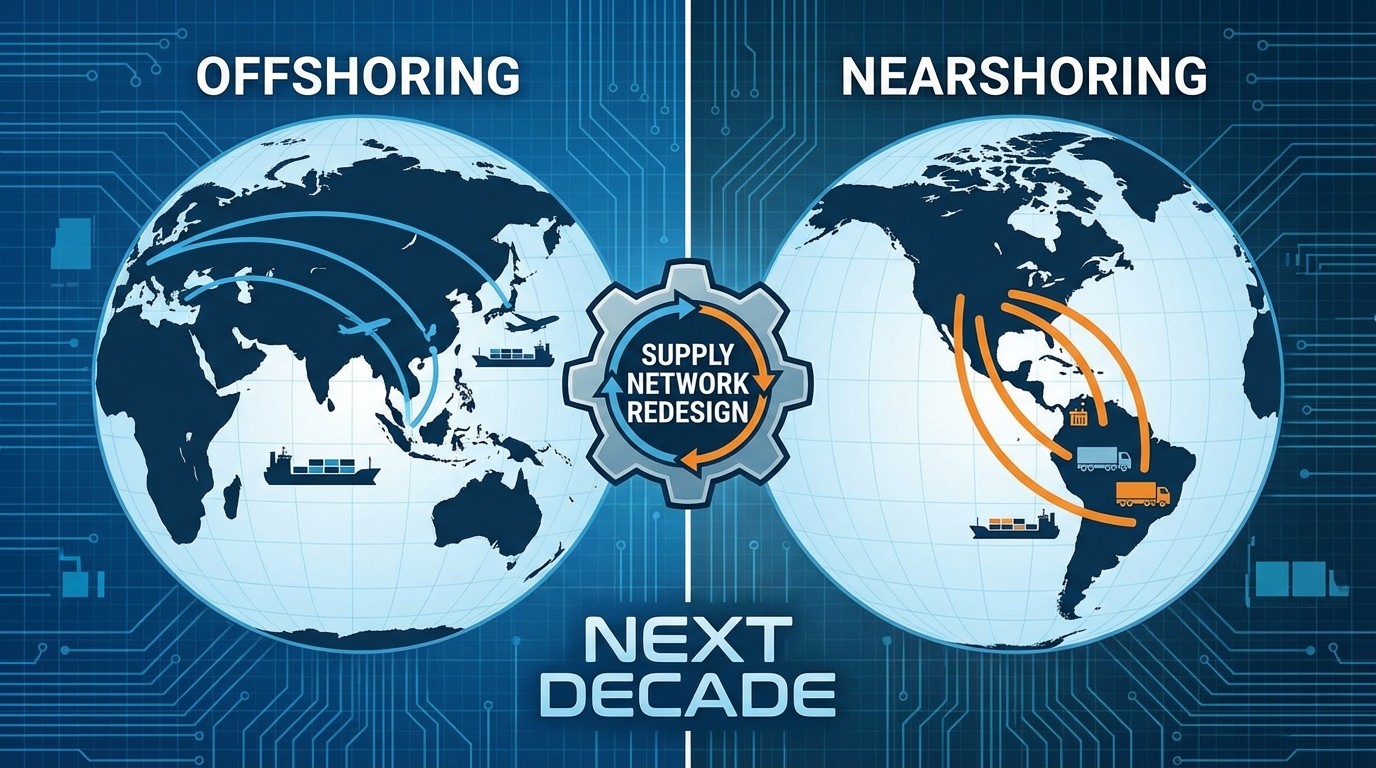
As global trade dynamics continue to evolve, organizations are reassessing long-established offshoring strategies that were built primarily around labor arbitrage and scale efficiencies. Cost advantages once associated with distant sourcing locations are increasingly offset by geopolitical risk, transportation volatility, regulatory complexity, currency fluctuations, and sustainability considerations. Nearshoring has emerged as a strategic alternative, offering greater responsiveness and risk mitigation. For supply chain leaders, the challenge is no longer choosing between nearshoring or offshoring, but designing hybrid sourcing portfolios that remain competitive under uncertainty over the next decade.
The Strategic Trade-Off
Offshoring continues to offer access to specialized manufacturing ecosystems, deep supplier networks, and cost efficiencies at scale. However, extended lead times, exposure to geopolitical disruptions, port congestion, and rising logistics costs can undermine service reliability and planning accuracy. Nearshoring, while often associated with higher unit manufacturing costs, enables:
Shorter replenishment cycles and reduced lead-time variability
Improved coordination and collaboration with suppliers
Faster response to demand volatility and customization requirements
Lower transportation risk and carbon footprint for regional distribution
Greater alignment with regional trade agreements and regulatory frameworks
The decision is increasingly portfolio-based, varying by product segment, customer promise, and market maturity.
Network Design Implications
Redesigning supply networks requires a more nuanced evaluation of:
Demand volatility and service-level expectations by market
Product modularity and customization requirements
Supplier capability maturity and scalability across regions
Total landed cost versus responsiveness trade-offs
Regulatory, tariff, and geopolitical exposure across sourcing geographies
Hybrid network models, combining offshore manufacturing for stable, cost-sensitive demand with nearshore capacity for volatile, time-sensitive products, are becoming a defining feature of modern supply chain design.
Strategic Recommendations
Supply chain leaders should:
Segment product portfolios based on demand predictability and service criticality
Conduct total cost and risk-adjusted sourcing analyses rather than unit cost comparisons
Pilot nearshoring initiatives for time-sensitive or high-variability product lines
Periodically reassess network design as trade policies, labor economics, and market demand evolve
Align sourcing strategies with sustainability targets and resilience objectives
Conclusion
Nearshoring and offshoring should be treated as complementary strategic levers rather than mutually exclusive choices. Organizations that redesign supply networks using a risk-adjusted, portfolio-based approach will be better positioned to balance cost efficiency with resilience, sustainability, and responsiveness over the next decade.
#Nearshoring #Offshoring #SupplyNetworkDesign #GlobalSourcing #SupplyChainStrategy #OperationalResilience #NetworkOptimization
More to Discover


Insights
Nearshoring vs Offshoring: How to Redesign Supply Networks for the Next Decade
Introduction
As global trade dynamics continue to evolve, organizations are reassessing long-established offshoring strategies that were built primarily around labor arbitrage and scale efficiencies. Cost advantages once associated with distant sourcing locations are increasingly offset by geopolitical risk, transportation volatility, regulatory complexity, currency fluctuations, and sustainability considerations. Nearshoring has emerged as a strategic alternative, offering greater responsiveness and risk mitigation. For supply chain leaders, the challenge is no longer choosing between nearshoring or offshoring, but designing hybrid sourcing portfolios that remain competitive under uncertainty over the next decade.
The Strategic Trade-Off
Offshoring continues to offer access to specialized manufacturing ecosystems, deep supplier networks, and cost efficiencies at scale. However, extended lead times, exposure to geopolitical disruptions, port congestion, and rising logistics costs can undermine service reliability and planning accuracy. Nearshoring, while often associated with higher unit manufacturing costs, enables:
Shorter replenishment cycles and reduced lead-time variability
Improved coordination and collaboration with suppliers
Faster response to demand volatility and customization requirements
Lower transportation risk and carbon footprint for regional distribution
Greater alignment with regional trade agreements and regulatory frameworks
The decision is increasingly portfolio-based, varying by product segment, customer promise, and market maturity.
Network Design Implications
Redesigning supply networks requires a more nuanced evaluation of:
Demand volatility and service-level expectations by market
Product modularity and customization requirements
Supplier capability maturity and scalability across regions
Total landed cost versus responsiveness trade-offs
Regulatory, tariff, and geopolitical exposure across sourcing geographies
Hybrid network models, combining offshore manufacturing for stable, cost-sensitive demand with nearshore capacity for volatile, time-sensitive products, are becoming a defining feature of modern supply chain design.
Strategic Recommendations
Supply chain leaders should:
Segment product portfolios based on demand predictability and service criticality
Conduct total cost and risk-adjusted sourcing analyses rather than unit cost comparisons
Pilot nearshoring initiatives for time-sensitive or high-variability product lines
Periodically reassess network design as trade policies, labor economics, and market demand evolve
Align sourcing strategies with sustainability targets and resilience objectives
Conclusion
Nearshoring and offshoring should be treated as complementary strategic levers rather than mutually exclusive choices. Organizations that redesign supply networks using a risk-adjusted, portfolio-based approach will be better positioned to balance cost efficiency with resilience, sustainability, and responsiveness over the next decade.
#Nearshoring #Offshoring #SupplyNetworkDesign #GlobalSourcing #SupplyChainStrategy #OperationalResilience #NetworkOptimization
More to Discover
Insights
Nearshoring vs Offshoring: How to Redesign Supply Networks for the Next Decade
Introduction
As global trade dynamics continue to evolve, organizations are reassessing long-established offshoring strategies that were built primarily around labor arbitrage and scale efficiencies. Cost advantages once associated with distant sourcing locations are increasingly offset by geopolitical risk, transportation volatility, regulatory complexity, currency fluctuations, and sustainability considerations. Nearshoring has emerged as a strategic alternative, offering greater responsiveness and risk mitigation. For supply chain leaders, the challenge is no longer choosing between nearshoring or offshoring, but designing hybrid sourcing portfolios that remain competitive under uncertainty over the next decade.
The Strategic Trade-Off
Offshoring continues to offer access to specialized manufacturing ecosystems, deep supplier networks, and cost efficiencies at scale. However, extended lead times, exposure to geopolitical disruptions, port congestion, and rising logistics costs can undermine service reliability and planning accuracy. Nearshoring, while often associated with higher unit manufacturing costs, enables:
Shorter replenishment cycles and reduced lead-time variability
Improved coordination and collaboration with suppliers
Faster response to demand volatility and customization requirements
Lower transportation risk and carbon footprint for regional distribution
Greater alignment with regional trade agreements and regulatory frameworks
The decision is increasingly portfolio-based, varying by product segment, customer promise, and market maturity.
Network Design Implications
Redesigning supply networks requires a more nuanced evaluation of:
Demand volatility and service-level expectations by market
Product modularity and customization requirements
Supplier capability maturity and scalability across regions
Total landed cost versus responsiveness trade-offs
Regulatory, tariff, and geopolitical exposure across sourcing geographies
Hybrid network models, combining offshore manufacturing for stable, cost-sensitive demand with nearshore capacity for volatile, time-sensitive products, are becoming a defining feature of modern supply chain design.
Strategic Recommendations
Supply chain leaders should:
Segment product portfolios based on demand predictability and service criticality
Conduct total cost and risk-adjusted sourcing analyses rather than unit cost comparisons
Pilot nearshoring initiatives for time-sensitive or high-variability product lines
Periodically reassess network design as trade policies, labor economics, and market demand evolve
Align sourcing strategies with sustainability targets and resilience objectives
Conclusion
Nearshoring and offshoring should be treated as complementary strategic levers rather than mutually exclusive choices. Organizations that redesign supply networks using a risk-adjusted, portfolio-based approach will be better positioned to balance cost efficiency with resilience, sustainability, and responsiveness over the next decade.
#Nearshoring #Offshoring #SupplyNetworkDesign #GlobalSourcing #SupplyChainStrategy #OperationalResilience #NetworkOptimization