Insights
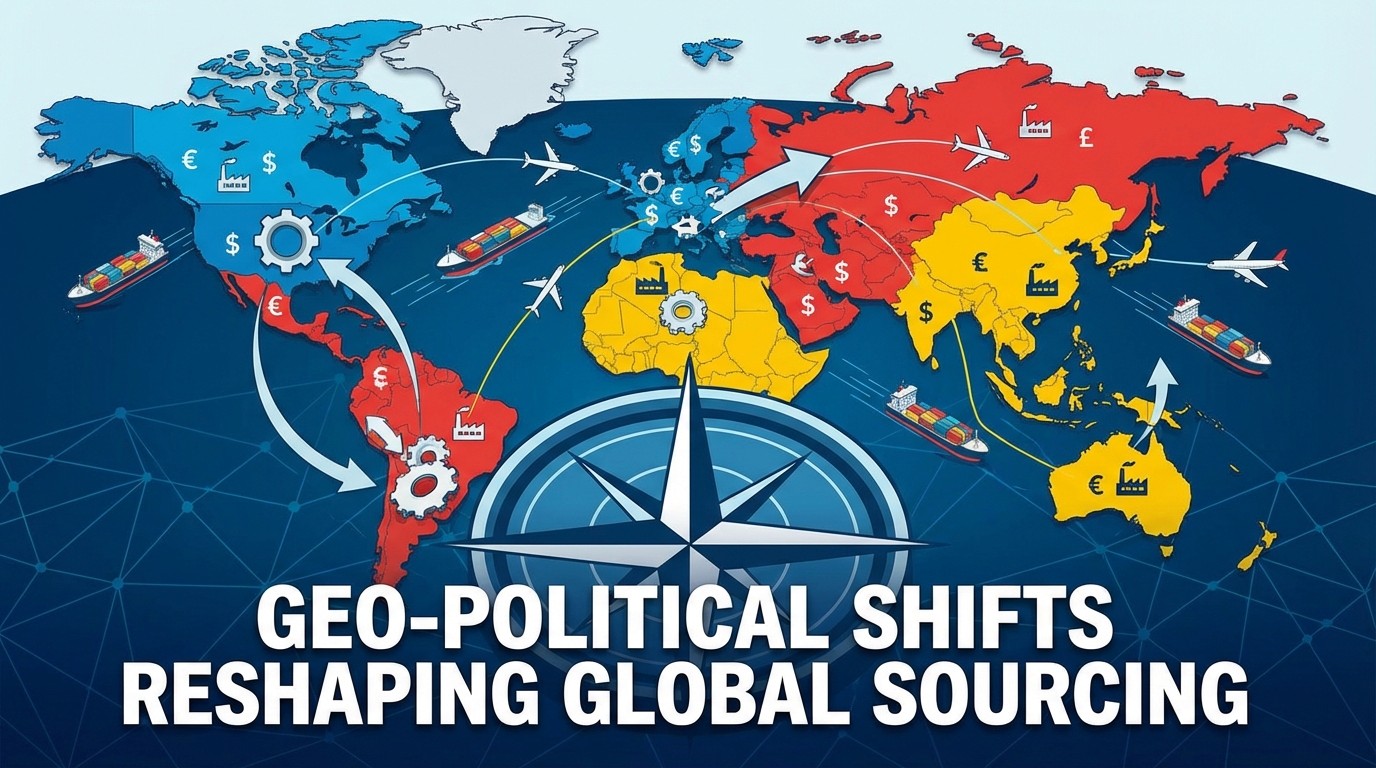
How Geo-Political Shifts Are Reshaping Global Sourcing Strategies
Introduction
Global sourcing strategies are increasingly shaped by geopolitical dynamics. Trade tensions, regulatory realignments, regional conflicts, and economic sanctions are no longer peripheral risks, they are central factors influencing supplier selection, manufacturing footprints, and logistics network design. For operations leaders, understanding these shifts is critical to sustaining continuity and competitiveness.
The New Geopolitical Reality
Recent years have introduced heightened uncertainty into global trade. Key geopolitical developments affecting sourcing strategies include:
Shifting trade agreements and tariff structures
Export controls and sanctions regimes
Regional conflicts impacting transit routes
National policies prioritizing domestic manufacturing
Regulatory divergence across major trading blocs
These changes are forcing organizations to reassess supplier dependencies and geographic concentration risks.
Impact on Global Sourcing Models
Traditional sourcing models prioritized cost efficiency and economies of scale. Geopolitical volatility is now prompting a rebalancing toward:
Multi-country sourcing strategies
Nearshoring and regionalization
Dual-sourcing for critical components
Supplier diversification across political risk profiles
Increased emphasis on supplier transparency and compliance
The focus is shifting from lowest-cost sourcing to risk-adjusted sourcing.
Industry Case Examples
Manufacturers in electronics, automotive, and pharmaceuticals have already adjusted sourcing footprints in response to regulatory shifts and trade barriers. Organizations that previously relied on single-region sourcing models are increasingly developing parallel supply lines to mitigate disruption risks.
Retailers have similarly diversified supplier bases to ensure continuity of seasonal inventory, particularly in high-demand cycles where delays have outsized commercial impact.
Strategic Response Framework
Supply chain leaders should consider the following actions:
Conduct geopolitical risk assessments at supplier and country levels
Map critical dependencies across the supply network
Develop regional sourcing alternatives for high-risk categories
Integrate geopolitical risk indicators into procurement planning
Strengthen collaboration with legal and compliance teams
Conclusion
Geopolitical shifts are no longer episodic disruptions, they represent a structural change in how global sourcing must be approached. Organizations that proactively embed geopolitical risk into sourcing strategy design will be better positioned to sustain resilience, regulatory compliance, and operational continuity in an increasingly fragmented global trade environment.
#GlobalSourcing #GeopoliticalRisk #SupplyChainStrategy #Procurement #TradePolicy #OperationalResilience #RiskManagement
More to Discover


Insights
How Geo-Political Shifts Are Reshaping Global Sourcing Strategies
Introduction
Global sourcing strategies are increasingly shaped by geopolitical dynamics. Trade tensions, regulatory realignments, regional conflicts, and economic sanctions are no longer peripheral risks, they are central factors influencing supplier selection, manufacturing footprints, and logistics network design. For operations leaders, understanding these shifts is critical to sustaining continuity and competitiveness.
The New Geopolitical Reality
Recent years have introduced heightened uncertainty into global trade. Key geopolitical developments affecting sourcing strategies include:
Shifting trade agreements and tariff structures
Export controls and sanctions regimes
Regional conflicts impacting transit routes
National policies prioritizing domestic manufacturing
Regulatory divergence across major trading blocs
These changes are forcing organizations to reassess supplier dependencies and geographic concentration risks.
Impact on Global Sourcing Models
Traditional sourcing models prioritized cost efficiency and economies of scale. Geopolitical volatility is now prompting a rebalancing toward:
Multi-country sourcing strategies
Nearshoring and regionalization
Dual-sourcing for critical components
Supplier diversification across political risk profiles
Increased emphasis on supplier transparency and compliance
The focus is shifting from lowest-cost sourcing to risk-adjusted sourcing.
Industry Case Examples
Manufacturers in electronics, automotive, and pharmaceuticals have already adjusted sourcing footprints in response to regulatory shifts and trade barriers. Organizations that previously relied on single-region sourcing models are increasingly developing parallel supply lines to mitigate disruption risks.
Retailers have similarly diversified supplier bases to ensure continuity of seasonal inventory, particularly in high-demand cycles where delays have outsized commercial impact.
Strategic Response Framework
Supply chain leaders should consider the following actions:
Conduct geopolitical risk assessments at supplier and country levels
Map critical dependencies across the supply network
Develop regional sourcing alternatives for high-risk categories
Integrate geopolitical risk indicators into procurement planning
Strengthen collaboration with legal and compliance teams
Conclusion
Geopolitical shifts are no longer episodic disruptions, they represent a structural change in how global sourcing must be approached. Organizations that proactively embed geopolitical risk into sourcing strategy design will be better positioned to sustain resilience, regulatory compliance, and operational continuity in an increasingly fragmented global trade environment.
#GlobalSourcing #GeopoliticalRisk #SupplyChainStrategy #Procurement #TradePolicy #OperationalResilience #RiskManagement
More to Discover
Insights
How Geo-Political Shifts Are Reshaping Global Sourcing Strategies
Introduction
Global sourcing strategies are increasingly shaped by geopolitical dynamics. Trade tensions, regulatory realignments, regional conflicts, and economic sanctions are no longer peripheral risks, they are central factors influencing supplier selection, manufacturing footprints, and logistics network design. For operations leaders, understanding these shifts is critical to sustaining continuity and competitiveness.
The New Geopolitical Reality
Recent years have introduced heightened uncertainty into global trade. Key geopolitical developments affecting sourcing strategies include:
Shifting trade agreements and tariff structures
Export controls and sanctions regimes
Regional conflicts impacting transit routes
National policies prioritizing domestic manufacturing
Regulatory divergence across major trading blocs
These changes are forcing organizations to reassess supplier dependencies and geographic concentration risks.
Impact on Global Sourcing Models
Traditional sourcing models prioritized cost efficiency and economies of scale. Geopolitical volatility is now prompting a rebalancing toward:
Multi-country sourcing strategies
Nearshoring and regionalization
Dual-sourcing for critical components
Supplier diversification across political risk profiles
Increased emphasis on supplier transparency and compliance
The focus is shifting from lowest-cost sourcing to risk-adjusted sourcing.
Industry Case Examples
Manufacturers in electronics, automotive, and pharmaceuticals have already adjusted sourcing footprints in response to regulatory shifts and trade barriers. Organizations that previously relied on single-region sourcing models are increasingly developing parallel supply lines to mitigate disruption risks.
Retailers have similarly diversified supplier bases to ensure continuity of seasonal inventory, particularly in high-demand cycles where delays have outsized commercial impact.
Strategic Response Framework
Supply chain leaders should consider the following actions:
Conduct geopolitical risk assessments at supplier and country levels
Map critical dependencies across the supply network
Develop regional sourcing alternatives for high-risk categories
Integrate geopolitical risk indicators into procurement planning
Strengthen collaboration with legal and compliance teams
Conclusion
Geopolitical shifts are no longer episodic disruptions, they represent a structural change in how global sourcing must be approached. Organizations that proactively embed geopolitical risk into sourcing strategy design will be better positioned to sustain resilience, regulatory compliance, and operational continuity in an increasingly fragmented global trade environment.
#GlobalSourcing #GeopoliticalRisk #SupplyChainStrategy #Procurement #TradePolicy #OperationalResilience #RiskManagement