Insights
Supplier Scorecards: Measuring Performance Beyond Price
Executive Summary
Supplier performance has traditionally been measured through a narrow lens, with purchase price often dominating procurement decisions. While cost remains important, modern supply chains demand a more balanced approach. Supplier performance now directly influences product quality, customer satisfaction, operational resilience, innovation, and long-term business success.
Supplier scorecards provide a structured framework for evaluating suppliers across multiple performance dimensions, enabling organizations to make sourcing decisions based on total business value rather than cost alone. When implemented effectively, scorecards improve transparency, strengthen supplier relationships, and support continuous improvement.
Introduction
Every supplier relationship affects the performance of the entire supply chain.
Selecting a supplier is no longer simply about finding the lowest bidder. Organizations need partners who can consistently deliver quality, respond to changing business needs, support innovation, and contribute to long-term operational success.
Many businesses still rely on informal supplier reviews that focus mainly on pricing and delivery performance. While these indicators remain valuable, they often overlook factors such as responsiveness, sustainability, risk management, and strategic alignment.
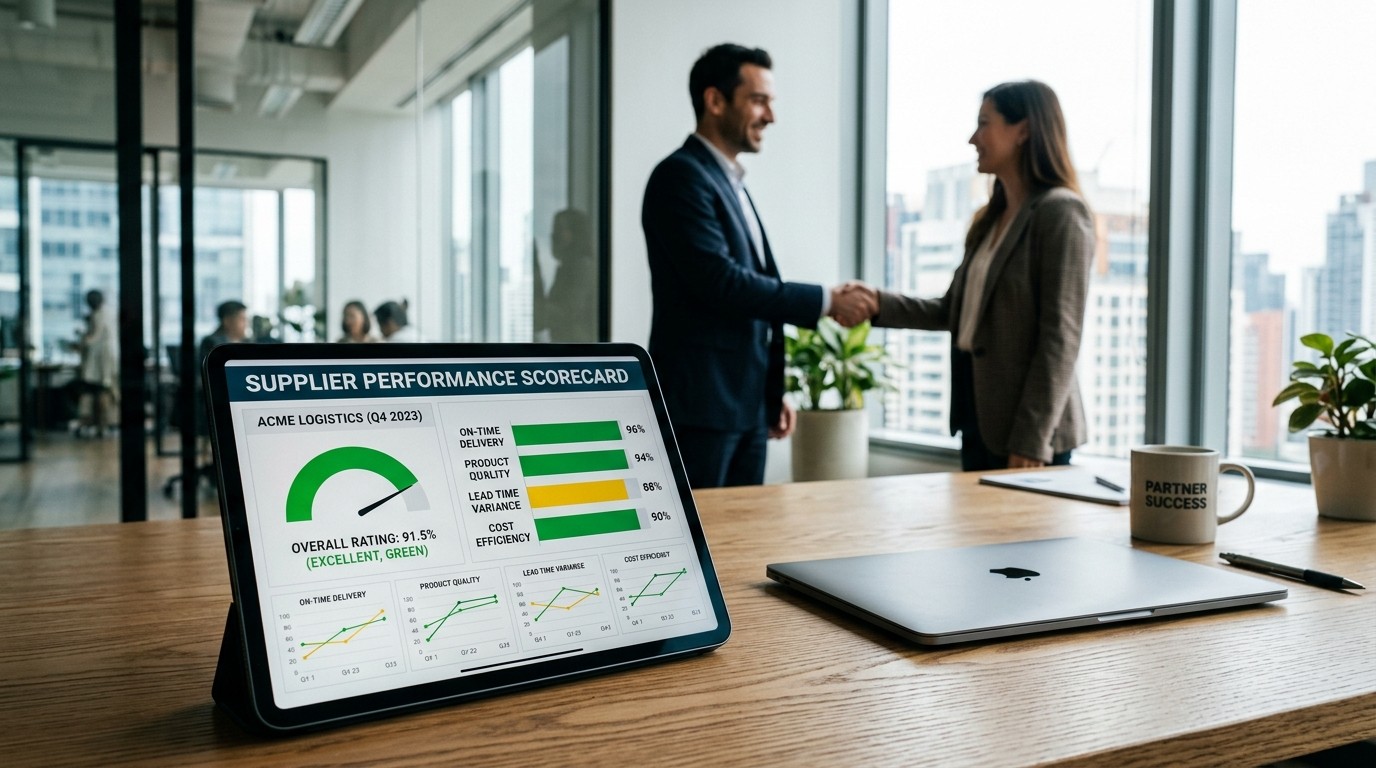
Supplier scorecards address this gap by providing a consistent, data-driven approach to evaluating supplier performance.
Why Supplier Scorecards Matter
An effective supplier scorecard helps organizations:
Improve supplier accountability
Increase operational transparency
Support objective sourcing decisions
Detect performance issues early
Encourage supplier development
Reduce operational risk
Strengthen collaboration
Improve customer service
Rather than acting as a reporting tool, a scorecard becomes a foundation for stronger supplier relationships and better business decisions.
Looking Beyond Purchase Price
Historically, procurement teams evaluated suppliers using three simple questions:
Did they deliver on time?
Was the quality acceptable?
Was the price competitive?
Today's business environment requires a broader perspective.
A supplier offering the lowest price may generate higher warranty costs, inconsistent quality, slower response times, or greater operational risk. Conversely, a supplier with slightly higher pricing may provide superior service, technical expertise, innovation, and greater long-term value.
Supplier scorecards help organizations evaluate suppliers based on their overall contribution to business performance.
Building a Balanced Supplier Scorecard
High-performing organizations typically evaluate suppliers across six key areas.
Delivery Performance
Reliable delivery remains fundamental to supply chain success. Key indicators include On-Time In-Full (OTIF), lead-time consistency, schedule adherence, and delivery accuracy.
Quality Performance
Quality metrics include defect rates, warranty claims, customer complaints, audit results, and corrective action responsiveness. Consistent quality reduces operational costs and improves customer satisfaction.
Commercial Performance
Commercial evaluation extends beyond purchase price to include Total Cost of Ownership (TCO), contract compliance, cost transparency, and continuous cost improvement initiatives.
Responsiveness
A supplier's ability to respond quickly to changing demand, resolve issues, and communicate effectively becomes particularly valuable during operational disruptions.
Innovation
Strategic suppliers should contribute ideas that improve products, processes, automation, or operational efficiency. Innovation has become an increasingly important source of competitive advantage.
Sustainability and Risk
Modern scorecards should also consider Environmental, Social, and Governance (ESG) performance, ethical sourcing, regulatory compliance, and supply chain risk management.
Together, these dimensions provide a more complete picture of supplier value.
Tailoring Scorecards to Supplier Importance
Not every supplier should be evaluated in the same way.
Transactional suppliers may be assessed primarily on cost, quality, and delivery.
Preferred suppliers require additional emphasis on responsiveness and continuous improvement.
Strategic suppliers should also be evaluated on innovation, sustainability, risk management, and long-term business contribution.
Aligning scorecards with supplier importance ensures that performance expectations remain appropriate and meaningful.
The Role of Digital Technologies
Modern procurement platforms have transformed supplier scorecards from static reports into real-time performance management tools.
Business Intelligence dashboards, supplier portals, Artificial Intelligence, and predictive analytics now allow organizations to:
Monitor supplier performance continuously
Detect emerging risks early
Benchmark supplier performance
Improve collaboration through shared performance data
Support more informed sourcing decisions
Technology strengthens supplier management by providing better visibility, not by replacing professional judgment.
Best Practices
Organizations can maximize the value of supplier scorecards by following several best practices:
Align KPIs with overall business objectives.
Keep scorecards balanced rather than focusing on a single metric.
Use standardized evaluation criteria across suppliers.
Conduct regular performance reviews.
Share results openly with suppliers.
Use scorecards to encourage improvement rather than assign blame.
Review KPIs periodically as business priorities evolve.
The most effective scorecards become collaborative management tools rather than compliance checklists.
Common Mistakes to Avoid
Supplier scorecards often fail because organizations:
Measure too many KPIs.
Focus excessively on purchase price.
Use inconsistent scoring methods.
Ignore supplier feedback.
Conduct reviews too infrequently.
Fail to act on performance insights.
Scorecards create value only when they lead to meaningful improvements.
Future Outlook
Supplier performance management is becoming increasingly intelligent through Artificial Intelligence, predictive analytics, and connected procurement platforms.
Future scorecards will provide continuous performance monitoring, predictive risk analysis, broader visibility across multi-tier supply networks, and greater emphasis on sustainability and ESG performance.
Organizations that adopt these capabilities will build stronger supplier ecosystems and more resilient supply chains.
Key Takeaways
Supplier scorecards measure total business value rather than purchase price alone.
Balanced evaluation improves sourcing decisions and supplier collaboration.
Performance management should encourage continuous improvement.
Digital technologies provide real-time visibility and predictive insights.
Well-designed scorecards strengthen long-term supplier relationships and supply chain resilience.
Frequently Asked Questions
What is a supplier scorecard?
A supplier scorecard is a structured framework used to evaluate supplier performance across operational, commercial, strategic, and relationship-based criteria.
Why shouldn't suppliers be evaluated only on price?
Purchase price represents only one aspect of supplier value. Quality, reliability, innovation, responsiveness, and sustainability often have a greater impact on long-term business performance.
How often should supplier performance be reviewed?
Critical operational metrics should be monitored continuously where possible, while formal supplier reviews are typically conducted monthly or quarterly depending on the supplier's strategic importance.
Conclusion
Supplier scorecards have evolved from simple procurement reports into strategic management tools that improve supplier relationships, operational performance, and long-term business success.
By evaluating suppliers across multiple dimensions, including quality, delivery, responsiveness, innovation, sustainability, and risk, organizations gain a more complete understanding of supplier value and make better sourcing decisions.
In an increasingly competitive and interconnected business environment, organizations that use supplier scorecards effectively will build stronger partnerships, improve resilience, and transform procurement into a strategic driver of enterprise growth.
Hashtags
#SupplierScorecards #SupplierPerformance #ProcurementExcellence #StrategicSourcing #SupplierRelationshipManagement #ProcurementLeadership #SupplyChainManagement #OperationalExcellence #DigitalProcurement #ContinuousImprovement
More to Discover


Insights
Supplier Scorecards: Measuring Performance Beyond Price
Executive Summary
Supplier performance has traditionally been measured through a narrow lens, with purchase price often dominating procurement decisions. While cost remains important, modern supply chains demand a more balanced approach. Supplier performance now directly influences product quality, customer satisfaction, operational resilience, innovation, and long-term business success.
Supplier scorecards provide a structured framework for evaluating suppliers across multiple performance dimensions, enabling organizations to make sourcing decisions based on total business value rather than cost alone. When implemented effectively, scorecards improve transparency, strengthen supplier relationships, and support continuous improvement.
Introduction
Every supplier relationship affects the performance of the entire supply chain.
Selecting a supplier is no longer simply about finding the lowest bidder. Organizations need partners who can consistently deliver quality, respond to changing business needs, support innovation, and contribute to long-term operational success.
Many businesses still rely on informal supplier reviews that focus mainly on pricing and delivery performance. While these indicators remain valuable, they often overlook factors such as responsiveness, sustainability, risk management, and strategic alignment.
Supplier scorecards address this gap by providing a consistent, data-driven approach to evaluating supplier performance.
Why Supplier Scorecards Matter
An effective supplier scorecard helps organizations:
Improve supplier accountability
Increase operational transparency
Support objective sourcing decisions
Detect performance issues early
Encourage supplier development
Reduce operational risk
Strengthen collaboration
Improve customer service
Rather than acting as a reporting tool, a scorecard becomes a foundation for stronger supplier relationships and better business decisions.
Looking Beyond Purchase Price
Historically, procurement teams evaluated suppliers using three simple questions:
Did they deliver on time?
Was the quality acceptable?
Was the price competitive?
Today's business environment requires a broader perspective.
A supplier offering the lowest price may generate higher warranty costs, inconsistent quality, slower response times, or greater operational risk. Conversely, a supplier with slightly higher pricing may provide superior service, technical expertise, innovation, and greater long-term value.
Supplier scorecards help organizations evaluate suppliers based on their overall contribution to business performance.
Building a Balanced Supplier Scorecard
High-performing organizations typically evaluate suppliers across six key areas.
Delivery Performance
Reliable delivery remains fundamental to supply chain success. Key indicators include On-Time In-Full (OTIF), lead-time consistency, schedule adherence, and delivery accuracy.
Quality Performance
Quality metrics include defect rates, warranty claims, customer complaints, audit results, and corrective action responsiveness. Consistent quality reduces operational costs and improves customer satisfaction.
Commercial Performance
Commercial evaluation extends beyond purchase price to include Total Cost of Ownership (TCO), contract compliance, cost transparency, and continuous cost improvement initiatives.
Responsiveness
A supplier's ability to respond quickly to changing demand, resolve issues, and communicate effectively becomes particularly valuable during operational disruptions.
Innovation
Strategic suppliers should contribute ideas that improve products, processes, automation, or operational efficiency. Innovation has become an increasingly important source of competitive advantage.
Sustainability and Risk
Modern scorecards should also consider Environmental, Social, and Governance (ESG) performance, ethical sourcing, regulatory compliance, and supply chain risk management.
Together, these dimensions provide a more complete picture of supplier value.
Tailoring Scorecards to Supplier Importance
Not every supplier should be evaluated in the same way.
Transactional suppliers may be assessed primarily on cost, quality, and delivery.
Preferred suppliers require additional emphasis on responsiveness and continuous improvement.
Strategic suppliers should also be evaluated on innovation, sustainability, risk management, and long-term business contribution.
Aligning scorecards with supplier importance ensures that performance expectations remain appropriate and meaningful.
The Role of Digital Technologies
Modern procurement platforms have transformed supplier scorecards from static reports into real-time performance management tools.
Business Intelligence dashboards, supplier portals, Artificial Intelligence, and predictive analytics now allow organizations to:
Monitor supplier performance continuously
Detect emerging risks early
Benchmark supplier performance
Improve collaboration through shared performance data
Support more informed sourcing decisions
Technology strengthens supplier management by providing better visibility, not by replacing professional judgment.
Best Practices
Organizations can maximize the value of supplier scorecards by following several best practices:
Align KPIs with overall business objectives.
Keep scorecards balanced rather than focusing on a single metric.
Use standardized evaluation criteria across suppliers.
Conduct regular performance reviews.
Share results openly with suppliers.
Use scorecards to encourage improvement rather than assign blame.
Review KPIs periodically as business priorities evolve.
The most effective scorecards become collaborative management tools rather than compliance checklists.
Common Mistakes to Avoid
Supplier scorecards often fail because organizations:
Measure too many KPIs.
Focus excessively on purchase price.
Use inconsistent scoring methods.
Ignore supplier feedback.
Conduct reviews too infrequently.
Fail to act on performance insights.
Scorecards create value only when they lead to meaningful improvements.
Future Outlook
Supplier performance management is becoming increasingly intelligent through Artificial Intelligence, predictive analytics, and connected procurement platforms.
Future scorecards will provide continuous performance monitoring, predictive risk analysis, broader visibility across multi-tier supply networks, and greater emphasis on sustainability and ESG performance.
Organizations that adopt these capabilities will build stronger supplier ecosystems and more resilient supply chains.
Key Takeaways
Supplier scorecards measure total business value rather than purchase price alone.
Balanced evaluation improves sourcing decisions and supplier collaboration.
Performance management should encourage continuous improvement.
Digital technologies provide real-time visibility and predictive insights.
Well-designed scorecards strengthen long-term supplier relationships and supply chain resilience.
Frequently Asked Questions
What is a supplier scorecard?
A supplier scorecard is a structured framework used to evaluate supplier performance across operational, commercial, strategic, and relationship-based criteria.
Why shouldn't suppliers be evaluated only on price?
Purchase price represents only one aspect of supplier value. Quality, reliability, innovation, responsiveness, and sustainability often have a greater impact on long-term business performance.
How often should supplier performance be reviewed?
Critical operational metrics should be monitored continuously where possible, while formal supplier reviews are typically conducted monthly or quarterly depending on the supplier's strategic importance.
Conclusion
Supplier scorecards have evolved from simple procurement reports into strategic management tools that improve supplier relationships, operational performance, and long-term business success.
By evaluating suppliers across multiple dimensions, including quality, delivery, responsiveness, innovation, sustainability, and risk, organizations gain a more complete understanding of supplier value and make better sourcing decisions.
In an increasingly competitive and interconnected business environment, organizations that use supplier scorecards effectively will build stronger partnerships, improve resilience, and transform procurement into a strategic driver of enterprise growth.
Hashtags
#SupplierScorecards #SupplierPerformance #ProcurementExcellence #StrategicSourcing #SupplierRelationshipManagement #ProcurementLeadership #SupplyChainManagement #OperationalExcellence #DigitalProcurement #ContinuousImprovement
More to Discover
Insights
Supplier Scorecards: Measuring Performance Beyond Price
Executive Summary
Supplier performance has traditionally been measured through a narrow lens, with purchase price often dominating procurement decisions. While cost remains important, modern supply chains demand a more balanced approach. Supplier performance now directly influences product quality, customer satisfaction, operational resilience, innovation, and long-term business success.
Supplier scorecards provide a structured framework for evaluating suppliers across multiple performance dimensions, enabling organizations to make sourcing decisions based on total business value rather than cost alone. When implemented effectively, scorecards improve transparency, strengthen supplier relationships, and support continuous improvement.
Introduction
Every supplier relationship affects the performance of the entire supply chain.
Selecting a supplier is no longer simply about finding the lowest bidder. Organizations need partners who can consistently deliver quality, respond to changing business needs, support innovation, and contribute to long-term operational success.
Many businesses still rely on informal supplier reviews that focus mainly on pricing and delivery performance. While these indicators remain valuable, they often overlook factors such as responsiveness, sustainability, risk management, and strategic alignment.
Supplier scorecards address this gap by providing a consistent, data-driven approach to evaluating supplier performance.
Why Supplier Scorecards Matter
An effective supplier scorecard helps organizations:
Improve supplier accountability
Increase operational transparency
Support objective sourcing decisions
Detect performance issues early
Encourage supplier development
Reduce operational risk
Strengthen collaboration
Improve customer service
Rather than acting as a reporting tool, a scorecard becomes a foundation for stronger supplier relationships and better business decisions.
Looking Beyond Purchase Price
Historically, procurement teams evaluated suppliers using three simple questions:
Did they deliver on time?
Was the quality acceptable?
Was the price competitive?
Today's business environment requires a broader perspective.
A supplier offering the lowest price may generate higher warranty costs, inconsistent quality, slower response times, or greater operational risk. Conversely, a supplier with slightly higher pricing may provide superior service, technical expertise, innovation, and greater long-term value.
Supplier scorecards help organizations evaluate suppliers based on their overall contribution to business performance.
Building a Balanced Supplier Scorecard
High-performing organizations typically evaluate suppliers across six key areas.
Delivery Performance
Reliable delivery remains fundamental to supply chain success. Key indicators include On-Time In-Full (OTIF), lead-time consistency, schedule adherence, and delivery accuracy.
Quality Performance
Quality metrics include defect rates, warranty claims, customer complaints, audit results, and corrective action responsiveness. Consistent quality reduces operational costs and improves customer satisfaction.
Commercial Performance
Commercial evaluation extends beyond purchase price to include Total Cost of Ownership (TCO), contract compliance, cost transparency, and continuous cost improvement initiatives.
Responsiveness
A supplier's ability to respond quickly to changing demand, resolve issues, and communicate effectively becomes particularly valuable during operational disruptions.
Innovation
Strategic suppliers should contribute ideas that improve products, processes, automation, or operational efficiency. Innovation has become an increasingly important source of competitive advantage.
Sustainability and Risk
Modern scorecards should also consider Environmental, Social, and Governance (ESG) performance, ethical sourcing, regulatory compliance, and supply chain risk management.
Together, these dimensions provide a more complete picture of supplier value.
Tailoring Scorecards to Supplier Importance
Not every supplier should be evaluated in the same way.
Transactional suppliers may be assessed primarily on cost, quality, and delivery.
Preferred suppliers require additional emphasis on responsiveness and continuous improvement.
Strategic suppliers should also be evaluated on innovation, sustainability, risk management, and long-term business contribution.
Aligning scorecards with supplier importance ensures that performance expectations remain appropriate and meaningful.
The Role of Digital Technologies
Modern procurement platforms have transformed supplier scorecards from static reports into real-time performance management tools.
Business Intelligence dashboards, supplier portals, Artificial Intelligence, and predictive analytics now allow organizations to:
Monitor supplier performance continuously
Detect emerging risks early
Benchmark supplier performance
Improve collaboration through shared performance data
Support more informed sourcing decisions
Technology strengthens supplier management by providing better visibility, not by replacing professional judgment.
Best Practices
Organizations can maximize the value of supplier scorecards by following several best practices:
Align KPIs with overall business objectives.
Keep scorecards balanced rather than focusing on a single metric.
Use standardized evaluation criteria across suppliers.
Conduct regular performance reviews.
Share results openly with suppliers.
Use scorecards to encourage improvement rather than assign blame.
Review KPIs periodically as business priorities evolve.
The most effective scorecards become collaborative management tools rather than compliance checklists.
Common Mistakes to Avoid
Supplier scorecards often fail because organizations:
Measure too many KPIs.
Focus excessively on purchase price.
Use inconsistent scoring methods.
Ignore supplier feedback.
Conduct reviews too infrequently.
Fail to act on performance insights.
Scorecards create value only when they lead to meaningful improvements.
Future Outlook
Supplier performance management is becoming increasingly intelligent through Artificial Intelligence, predictive analytics, and connected procurement platforms.
Future scorecards will provide continuous performance monitoring, predictive risk analysis, broader visibility across multi-tier supply networks, and greater emphasis on sustainability and ESG performance.
Organizations that adopt these capabilities will build stronger supplier ecosystems and more resilient supply chains.
Key Takeaways
Supplier scorecards measure total business value rather than purchase price alone.
Balanced evaluation improves sourcing decisions and supplier collaboration.
Performance management should encourage continuous improvement.
Digital technologies provide real-time visibility and predictive insights.
Well-designed scorecards strengthen long-term supplier relationships and supply chain resilience.
Frequently Asked Questions
What is a supplier scorecard?
A supplier scorecard is a structured framework used to evaluate supplier performance across operational, commercial, strategic, and relationship-based criteria.
Why shouldn't suppliers be evaluated only on price?
Purchase price represents only one aspect of supplier value. Quality, reliability, innovation, responsiveness, and sustainability often have a greater impact on long-term business performance.
How often should supplier performance be reviewed?
Critical operational metrics should be monitored continuously where possible, while formal supplier reviews are typically conducted monthly or quarterly depending on the supplier's strategic importance.
Conclusion
Supplier scorecards have evolved from simple procurement reports into strategic management tools that improve supplier relationships, operational performance, and long-term business success.
By evaluating suppliers across multiple dimensions, including quality, delivery, responsiveness, innovation, sustainability, and risk, organizations gain a more complete understanding of supplier value and make better sourcing decisions.
In an increasingly competitive and interconnected business environment, organizations that use supplier scorecards effectively will build stronger partnerships, improve resilience, and transform procurement into a strategic driver of enterprise growth.
Hashtags
#SupplierScorecards #SupplierPerformance #ProcurementExcellence #StrategicSourcing #SupplierRelationshipManagement #ProcurementLeadership #SupplyChainManagement #OperationalExcellence #DigitalProcurement #ContinuousImprovement