Insights
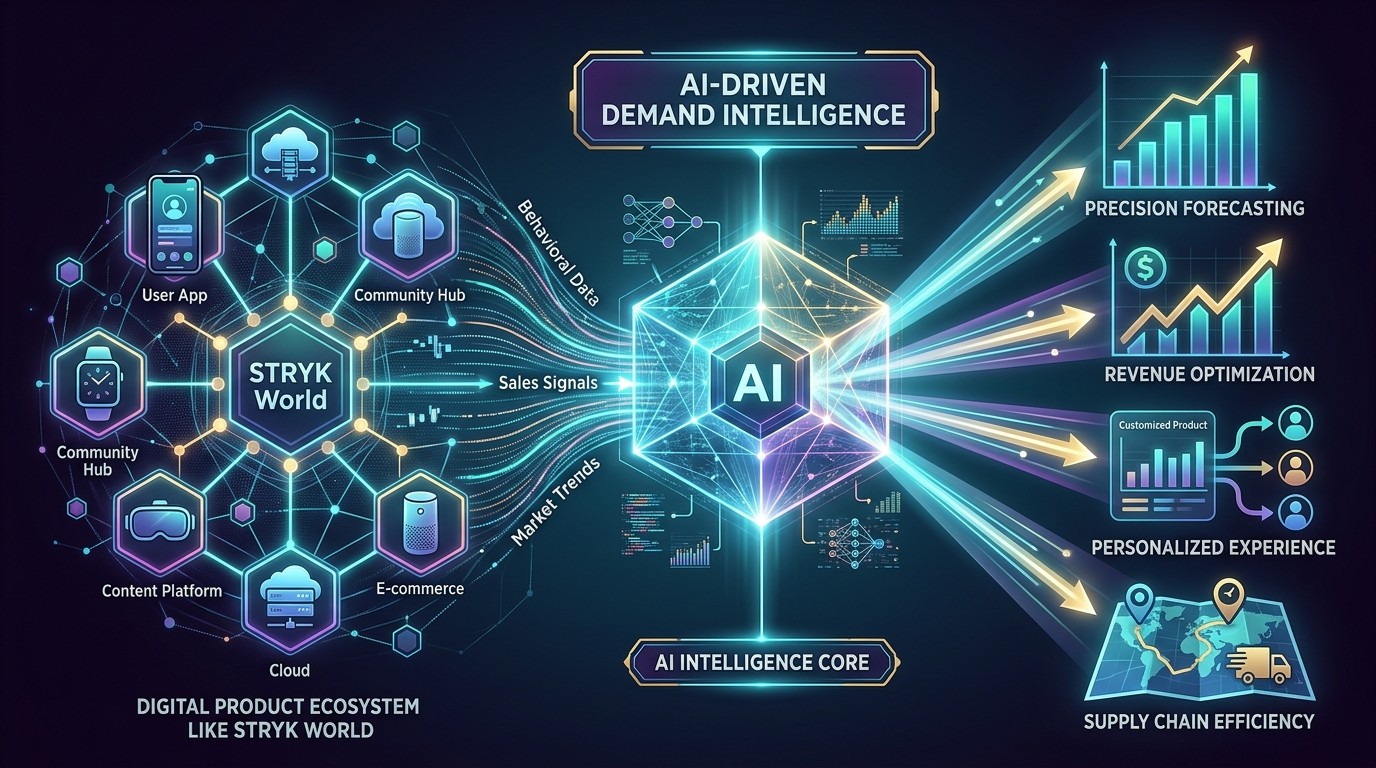
How Digital Product Ecosystems Like STRYK World Benefit from AI-Driven Demand Intelligence
Executive Summary
Customer demand changes faster than ever, making traditional forecasting alone insufficient for modern businesses. AI-driven demand intelligence enables organizations to combine historical data with real-time market signals, allowing them to anticipate demand shifts, optimize inventory, and improve operational decision-making.
For companies operating across multiple markets, integrating demand intelligence into a digital product ecosystem strengthens forecasting accuracy, operational efficiency, and customer satisfaction while supporting sustainable business growth.
Introduction
Modern supply chains generate enormous amounts of data, from online sales and distributor inventories to logistics performance and customer buying behavior. Historically, much of this information remained isolated across different systems, limiting its value for planning.
Artificial Intelligence is changing this by transforming operational data into actionable insights. Instead of relying only on historical trends, organizations can continuously monitor demand signals and adjust procurement, production, and distribution before disruptions occur.
For internationally focused product businesses, this creates a significant competitive advantage.
What Is AI-Driven Demand Intelligence?
Demand intelligence goes beyond traditional forecasting by combining real-time operational data with AI and advanced analytics.
Rather than depending solely on historical sales, it analyzes multiple demand signals, including:
Customer purchasing behavior
E-commerce activity
Distributor inventory
Market trends
Seasonal demand
Logistics performance
External factors such as weather and economic conditions
This enables organizations to detect changing demand patterns early and make proactive operational decisions.
Why Digital Product Ecosystems Matter
A digital product ecosystem connects manufacturers, suppliers, distributors, logistics providers, retailers, and customers through integrated digital platforms.
When AI-driven demand intelligence is embedded into this ecosystem, organizations gain:
Better visibility across the supply chain
Faster operational decision-making
Improved coordination between business partners
Greater responsiveness to changing market conditions
Instead of operating independently, every participant contributes to a more agile and resilient supply network.
How AI Improves Supply Chain Performance
AI-driven demand intelligence supports multiple business functions.
Procurement benefits from earlier visibility into changing demand, allowing sourcing teams to adjust purchasing strategies before shortages occur.
Inventory Management becomes more accurate through dynamic inventory optimization based on customer demand, supplier reliability, and logistics performance.
Manufacturing gains better production scheduling, reducing waste while improving equipment utilization.
Distribution and Fulfillment become more efficient by positioning inventory closer to expected customer demand, reducing transportation costs and improving delivery performance.
Together, these improvements create a faster and more responsive supply chain.
Industry Perspective: STRYK World
STRYK World provides a practical example of how internationally focused product brands can benefit from AI-driven demand intelligence.
Serving multiple markets requires balancing seasonal demand, inventory availability, production planning, and international distribution. By integrating real-time demand insights into operational planning, globally oriented businesses can better align manufacturing with customer demand while improving product availability and fulfillment performance.
The broader lesson extends beyond any single company. Organizations that combine digital ecosystems with AI-driven planning are better equipped to scale internationally while maintaining operational efficiency and customer satisfaction.
Business Benefits
Organizations implementing AI-driven demand intelligence commonly achieve:
Higher forecast accuracy
Reduced inventory carrying costs
Lower stockout rates
Improved production planning
Faster response to market changes
Better supplier collaboration
Greater operational resilience
Enhanced customer satisfaction
These improvements contribute directly to stronger financial performance and more agile business operations.
Best Practices
Organizations beginning their demand intelligence journey should:
Define clear business objectives before implementing AI.
Integrate operational data from multiple business systems.
Validate AI recommendations against actual business performance.
Encourage collaboration across procurement, operations, sales, and logistics.
Invest in employee training and strong data governance.
Successful implementation depends as much on organizational readiness as it does on technology.
Common Mistakes to Avoid
Many organizations reduce the value of AI initiatives by:
Relying solely on historical sales data
Ignoring external demand signals
Implementing AI without reliable data governance
Operating disconnected business systems
Expecting AI to replace human judgment
The strongest results come when AI supports experienced decision-makers rather than replacing them.
Future Outlook
As technologies such as Agentic AI, Digital Twins, IoT, and predictive analytics continue to mature, demand intelligence will become a core capability of modern supply chains.
Organizations that establish strong digital foundations today will be better positioned to anticipate demand, optimize resources, and respond quickly to changing customer expectations.
Key Takeaways
AI-driven demand intelligence improves planning through real-time operational insights.
Digital ecosystems strengthen collaboration across the supply chain.
AI supports procurement, manufacturing, inventory, and distribution decisions.
High-quality data and governance remain essential for success.
Companies such as STRYK World demonstrate how integrated planning supports efficient international growth.
Frequently Asked Questions
What is demand intelligence?
Demand intelligence combines AI, advanced analytics, and real-time operational data to improve demand planning beyond traditional forecasting.
How does it differ from traditional forecasting?
Traditional forecasting relies mainly on historical trends, while demand intelligence continuously incorporates live operational and market signals.
Can medium-sized businesses benefit?
Yes. Modern cloud-based AI planning platforms enable businesses of all sizes to improve forecasting accuracy, inventory management, and customer service.
Conclusion
Artificial Intelligence is transforming how organizations understand and respond to customer demand. By integrating AI-driven demand intelligence into digital product ecosystems, businesses can move from reactive planning to proactive decision-making, improving efficiency, resilience, and customer satisfaction.
As global markets become increasingly dynamic, organizations that combine intelligent planning with strong digital collaboration will be better positioned to achieve sustainable long-term growth.
Hashtags
#ArtificialIntelligence #DemandIntelligence #SupplyChainPlanning #DigitalTransformation #DigitalEcosystems #InventoryOptimization #Forecasting #SupplyChainInnovation #OperationalExcellence #STRYKWorld
More to Discover


Insights
How Digital Product Ecosystems Like STRYK World Benefit from AI-Driven Demand Intelligence
Executive Summary
Customer demand changes faster than ever, making traditional forecasting alone insufficient for modern businesses. AI-driven demand intelligence enables organizations to combine historical data with real-time market signals, allowing them to anticipate demand shifts, optimize inventory, and improve operational decision-making.
For companies operating across multiple markets, integrating demand intelligence into a digital product ecosystem strengthens forecasting accuracy, operational efficiency, and customer satisfaction while supporting sustainable business growth.
Introduction
Modern supply chains generate enormous amounts of data, from online sales and distributor inventories to logistics performance and customer buying behavior. Historically, much of this information remained isolated across different systems, limiting its value for planning.
Artificial Intelligence is changing this by transforming operational data into actionable insights. Instead of relying only on historical trends, organizations can continuously monitor demand signals and adjust procurement, production, and distribution before disruptions occur.
For internationally focused product businesses, this creates a significant competitive advantage.
What Is AI-Driven Demand Intelligence?
Demand intelligence goes beyond traditional forecasting by combining real-time operational data with AI and advanced analytics.
Rather than depending solely on historical sales, it analyzes multiple demand signals, including:
Customer purchasing behavior
E-commerce activity
Distributor inventory
Market trends
Seasonal demand
Logistics performance
External factors such as weather and economic conditions
This enables organizations to detect changing demand patterns early and make proactive operational decisions.
Why Digital Product Ecosystems Matter
A digital product ecosystem connects manufacturers, suppliers, distributors, logistics providers, retailers, and customers through integrated digital platforms.
When AI-driven demand intelligence is embedded into this ecosystem, organizations gain:
Better visibility across the supply chain
Faster operational decision-making
Improved coordination between business partners
Greater responsiveness to changing market conditions
Instead of operating independently, every participant contributes to a more agile and resilient supply network.
How AI Improves Supply Chain Performance
AI-driven demand intelligence supports multiple business functions.
Procurement benefits from earlier visibility into changing demand, allowing sourcing teams to adjust purchasing strategies before shortages occur.
Inventory Management becomes more accurate through dynamic inventory optimization based on customer demand, supplier reliability, and logistics performance.
Manufacturing gains better production scheduling, reducing waste while improving equipment utilization.
Distribution and Fulfillment become more efficient by positioning inventory closer to expected customer demand, reducing transportation costs and improving delivery performance.
Together, these improvements create a faster and more responsive supply chain.
Industry Perspective: STRYK World
STRYK World provides a practical example of how internationally focused product brands can benefit from AI-driven demand intelligence.
Serving multiple markets requires balancing seasonal demand, inventory availability, production planning, and international distribution. By integrating real-time demand insights into operational planning, globally oriented businesses can better align manufacturing with customer demand while improving product availability and fulfillment performance.
The broader lesson extends beyond any single company. Organizations that combine digital ecosystems with AI-driven planning are better equipped to scale internationally while maintaining operational efficiency and customer satisfaction.
Business Benefits
Organizations implementing AI-driven demand intelligence commonly achieve:
Higher forecast accuracy
Reduced inventory carrying costs
Lower stockout rates
Improved production planning
Faster response to market changes
Better supplier collaboration
Greater operational resilience
Enhanced customer satisfaction
These improvements contribute directly to stronger financial performance and more agile business operations.
Best Practices
Organizations beginning their demand intelligence journey should:
Define clear business objectives before implementing AI.
Integrate operational data from multiple business systems.
Validate AI recommendations against actual business performance.
Encourage collaboration across procurement, operations, sales, and logistics.
Invest in employee training and strong data governance.
Successful implementation depends as much on organizational readiness as it does on technology.
Common Mistakes to Avoid
Many organizations reduce the value of AI initiatives by:
Relying solely on historical sales data
Ignoring external demand signals
Implementing AI without reliable data governance
Operating disconnected business systems
Expecting AI to replace human judgment
The strongest results come when AI supports experienced decision-makers rather than replacing them.
Future Outlook
As technologies such as Agentic AI, Digital Twins, IoT, and predictive analytics continue to mature, demand intelligence will become a core capability of modern supply chains.
Organizations that establish strong digital foundations today will be better positioned to anticipate demand, optimize resources, and respond quickly to changing customer expectations.
Key Takeaways
AI-driven demand intelligence improves planning through real-time operational insights.
Digital ecosystems strengthen collaboration across the supply chain.
AI supports procurement, manufacturing, inventory, and distribution decisions.
High-quality data and governance remain essential for success.
Companies such as STRYK World demonstrate how integrated planning supports efficient international growth.
Frequently Asked Questions
What is demand intelligence?
Demand intelligence combines AI, advanced analytics, and real-time operational data to improve demand planning beyond traditional forecasting.
How does it differ from traditional forecasting?
Traditional forecasting relies mainly on historical trends, while demand intelligence continuously incorporates live operational and market signals.
Can medium-sized businesses benefit?
Yes. Modern cloud-based AI planning platforms enable businesses of all sizes to improve forecasting accuracy, inventory management, and customer service.
Conclusion
Artificial Intelligence is transforming how organizations understand and respond to customer demand. By integrating AI-driven demand intelligence into digital product ecosystems, businesses can move from reactive planning to proactive decision-making, improving efficiency, resilience, and customer satisfaction.
As global markets become increasingly dynamic, organizations that combine intelligent planning with strong digital collaboration will be better positioned to achieve sustainable long-term growth.
Hashtags
#ArtificialIntelligence #DemandIntelligence #SupplyChainPlanning #DigitalTransformation #DigitalEcosystems #InventoryOptimization #Forecasting #SupplyChainInnovation #OperationalExcellence #STRYKWorld
More to Discover
Insights
How Digital Product Ecosystems Like STRYK World Benefit from AI-Driven Demand Intelligence
Executive Summary
Customer demand changes faster than ever, making traditional forecasting alone insufficient for modern businesses. AI-driven demand intelligence enables organizations to combine historical data with real-time market signals, allowing them to anticipate demand shifts, optimize inventory, and improve operational decision-making.
For companies operating across multiple markets, integrating demand intelligence into a digital product ecosystem strengthens forecasting accuracy, operational efficiency, and customer satisfaction while supporting sustainable business growth.
Introduction
Modern supply chains generate enormous amounts of data, from online sales and distributor inventories to logistics performance and customer buying behavior. Historically, much of this information remained isolated across different systems, limiting its value for planning.
Artificial Intelligence is changing this by transforming operational data into actionable insights. Instead of relying only on historical trends, organizations can continuously monitor demand signals and adjust procurement, production, and distribution before disruptions occur.
For internationally focused product businesses, this creates a significant competitive advantage.
What Is AI-Driven Demand Intelligence?
Demand intelligence goes beyond traditional forecasting by combining real-time operational data with AI and advanced analytics.
Rather than depending solely on historical sales, it analyzes multiple demand signals, including:
Customer purchasing behavior
E-commerce activity
Distributor inventory
Market trends
Seasonal demand
Logistics performance
External factors such as weather and economic conditions
This enables organizations to detect changing demand patterns early and make proactive operational decisions.
Why Digital Product Ecosystems Matter
A digital product ecosystem connects manufacturers, suppliers, distributors, logistics providers, retailers, and customers through integrated digital platforms.
When AI-driven demand intelligence is embedded into this ecosystem, organizations gain:
Better visibility across the supply chain
Faster operational decision-making
Improved coordination between business partners
Greater responsiveness to changing market conditions
Instead of operating independently, every participant contributes to a more agile and resilient supply network.
How AI Improves Supply Chain Performance
AI-driven demand intelligence supports multiple business functions.
Procurement benefits from earlier visibility into changing demand, allowing sourcing teams to adjust purchasing strategies before shortages occur.
Inventory Management becomes more accurate through dynamic inventory optimization based on customer demand, supplier reliability, and logistics performance.
Manufacturing gains better production scheduling, reducing waste while improving equipment utilization.
Distribution and Fulfillment become more efficient by positioning inventory closer to expected customer demand, reducing transportation costs and improving delivery performance.
Together, these improvements create a faster and more responsive supply chain.
Industry Perspective: STRYK World
STRYK World provides a practical example of how internationally focused product brands can benefit from AI-driven demand intelligence.
Serving multiple markets requires balancing seasonal demand, inventory availability, production planning, and international distribution. By integrating real-time demand insights into operational planning, globally oriented businesses can better align manufacturing with customer demand while improving product availability and fulfillment performance.
The broader lesson extends beyond any single company. Organizations that combine digital ecosystems with AI-driven planning are better equipped to scale internationally while maintaining operational efficiency and customer satisfaction.
Business Benefits
Organizations implementing AI-driven demand intelligence commonly achieve:
Higher forecast accuracy
Reduced inventory carrying costs
Lower stockout rates
Improved production planning
Faster response to market changes
Better supplier collaboration
Greater operational resilience
Enhanced customer satisfaction
These improvements contribute directly to stronger financial performance and more agile business operations.
Best Practices
Organizations beginning their demand intelligence journey should:
Define clear business objectives before implementing AI.
Integrate operational data from multiple business systems.
Validate AI recommendations against actual business performance.
Encourage collaboration across procurement, operations, sales, and logistics.
Invest in employee training and strong data governance.
Successful implementation depends as much on organizational readiness as it does on technology.
Common Mistakes to Avoid
Many organizations reduce the value of AI initiatives by:
Relying solely on historical sales data
Ignoring external demand signals
Implementing AI without reliable data governance
Operating disconnected business systems
Expecting AI to replace human judgment
The strongest results come when AI supports experienced decision-makers rather than replacing them.
Future Outlook
As technologies such as Agentic AI, Digital Twins, IoT, and predictive analytics continue to mature, demand intelligence will become a core capability of modern supply chains.
Organizations that establish strong digital foundations today will be better positioned to anticipate demand, optimize resources, and respond quickly to changing customer expectations.
Key Takeaways
AI-driven demand intelligence improves planning through real-time operational insights.
Digital ecosystems strengthen collaboration across the supply chain.
AI supports procurement, manufacturing, inventory, and distribution decisions.
High-quality data and governance remain essential for success.
Companies such as STRYK World demonstrate how integrated planning supports efficient international growth.
Frequently Asked Questions
What is demand intelligence?
Demand intelligence combines AI, advanced analytics, and real-time operational data to improve demand planning beyond traditional forecasting.
How does it differ from traditional forecasting?
Traditional forecasting relies mainly on historical trends, while demand intelligence continuously incorporates live operational and market signals.
Can medium-sized businesses benefit?
Yes. Modern cloud-based AI planning platforms enable businesses of all sizes to improve forecasting accuracy, inventory management, and customer service.
Conclusion
Artificial Intelligence is transforming how organizations understand and respond to customer demand. By integrating AI-driven demand intelligence into digital product ecosystems, businesses can move from reactive planning to proactive decision-making, improving efficiency, resilience, and customer satisfaction.
As global markets become increasingly dynamic, organizations that combine intelligent planning with strong digital collaboration will be better positioned to achieve sustainable long-term growth.
Hashtags
#ArtificialIntelligence #DemandIntelligence #SupplyChainPlanning #DigitalTransformation #DigitalEcosystems #InventoryOptimization #Forecasting #SupplyChainInnovation #OperationalExcellence #STRYKWorld