Insights
Agentic AI in Supply Chains: Moving Beyond Automation to Autonomous Decision-Making
Executive Summary
Artificial Intelligence is evolving beyond task automation into systems capable of making intelligent operational decisions. Known as Agentic AI, this next generation of AI can monitor events, evaluate alternatives, and initiate actions with minimal human intervention. Unlike traditional automation, which follows predefined rules, Agentic AI continuously learns from changing conditions to improve decision-making.
For supply chain leaders, this represents a major shift, from automating processes to creating autonomous, adaptive operations that improve agility, resilience, and business performance.
Introduction
Over the past decade, organizations have invested heavily in digital transformation through warehouse automation, robotic process automation (RPA), and workflow automation. These technologies have successfully improved efficiency by eliminating repetitive manual tasks.
However, modern supply chains operate in an environment where uncertainty is constant. Demand fluctuates rapidly, suppliers face unexpected disruptions, transportation networks experience delays, and customer expectations continue to rise.
Responding effectively requires more than automated workflows. It requires systems capable of interpreting changing conditions, evaluating multiple options, and making informed operational decisions in real time.
This is the role Agentic AI is beginning to play.
What Makes Agentic AI Different?
Traditional automation executes predefined instructions. It performs repetitive tasks efficiently but cannot adapt when circumstances change unexpectedly.
Typical examples include:
Automatically generating purchase orders
Scheduling warehouse labor
Processing invoices
Sending shipment notifications
Agentic AI moves beyond execution by introducing reasoning and adaptive decision-making.
Rather than waiting for human intervention, it can:
Continuously monitor inventory
Predict shortages before they occur
Evaluate supplier alternatives
Recommend optimal transportation routes
Adjust replenishment strategies
Learn from previous operational outcomes
Instead of asking "What happened?", organizations begin asking "What should happen next?"
This shift enables supply chains to become more proactive and resilient.
Practical Applications Across the Supply Chain
Intelligent Procurement
Agentic AI continuously evaluates supplier performance, commodity trends, market conditions, and operational risks. It can recommend alternative sourcing strategies before disruptions affect production.
Dynamic Inventory Management
Rather than relying on static reorder points, AI agents adjust inventory policies based on changing demand patterns, supplier reliability, promotional activity, seasonal fluctuations, and transportation constraints.
Transportation Optimization
AI agents can analyze carrier performance, weather conditions, fuel costs, route congestion, and customer priorities to optimize shipment planning in real time.
Production Scheduling
Manufacturers can use Agentic AI to rebalance production schedules automatically when equipment failures, material shortages, or unexpected demand changes occur.
Collectively, these capabilities improve responsiveness across the entire supply chain.
Business Benefits
Organizations adopting Agentic AI can expect several strategic advantages:
Faster operational decision-making
Improved supply chain agility
Better resource utilization
Reduced manual intervention
Higher forecast responsiveness
Greater resilience during disruptions
Perhaps the greatest benefit is that operational teams spend less time reacting to routine issues and more time focusing on strategic initiatives, supplier relationships, and continuous improvement.
Challenges Organizations Must Address
Although Agentic AI offers significant potential, successful implementation requires thoughtful planning.
Key considerations include:
High-quality and reliable operational data
Clear AI governance and accountability
Cybersecurity and data protection
Ethical decision-making frameworks
Human oversight for high-impact decisions
Workforce training and change management
Organizations should view Agentic AI as a long-term organizational capability rather than simply another technology investment.
Best Practices for Successful Adoption
Organizations can improve implementation success by following several proven practices:
Begin with clearly defined pilot projects.
Focus on high-value operational use cases.
Establish strong data governance before deployment.
Keep humans involved in strategic or high-risk decisions.
Continuously evaluate AI recommendations against business outcomes.
Scale gradually as organizational confidence and capability increase.
A phased implementation approach reduces risk while accelerating organizational learning.
Common Mistakes to Avoid
Many early AI initiatives fail because organizations focus on technology rather than operational readiness.
Common mistakes include:
Expecting AI to replace experienced professionals
Deploying AI without reliable enterprise data
Ignoring governance and accountability
Attempting enterprise-wide implementation too quickly
Measuring technology adoption instead of business value
Successful organizations prioritize measurable operational improvements over technical sophistication.
Future Outlook
Over the next decade, Agentic AI is expected to become a core capability within digital supply chains.
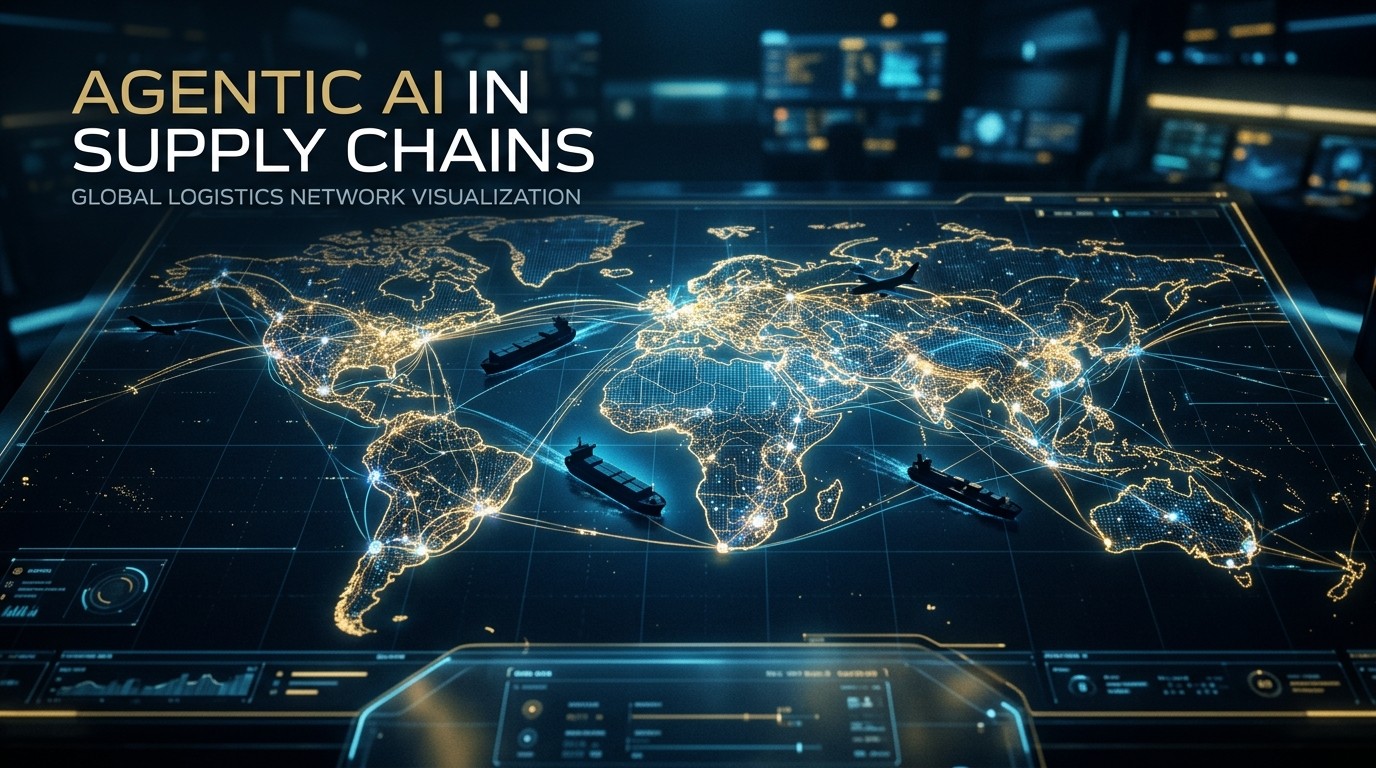
Future control towers will move beyond monitoring operations to autonomously coordinating procurement, inventory, transportation, and fulfillment activities while keeping human leaders informed and in control.
Organizations that begin experimenting with Agentic AI today will develop the experience, governance, and operational maturity needed to compete in increasingly complex global markets.
Key Takeaways
Agentic AI combines automation with intelligent decision-making.
It enables proactive rather than reactive supply chain management.
Applications span procurement, inventory, transportation, and production planning.
Strong governance, trusted data, and human oversight remain essential.
Organizations should adopt Agentic AI gradually through clearly defined business use cases.
Frequently Asked Questions
What is Agentic AI?
Agentic AI refers to AI systems capable of independently pursuing defined objectives by observing operational conditions, making decisions, and taking appropriate actions within established governance boundaries.
Will Agentic AI replace supply chain professionals?
No. Agentic AI is designed to augment human expertise by automating routine operational decisions while enabling professionals to focus on strategic planning, innovation, and relationship management.
Where should organizations begin?
The most effective starting points include inventory optimization, supplier performance monitoring, transportation planning, and demand management, areas where measurable business value can be demonstrated quickly.
Conclusion
Agentic AI represents the next major evolution in supply chain management. By combining automation with adaptive decision-making, organizations can build more responsive, resilient, and intelligent operations capable of navigating an increasingly uncertain business environment.
The future of supply chain excellence will not be defined by organizations that simply automate tasks, but by those that successfully combine human expertise with AI-driven operational intelligence to make faster, smarter, and more informed decisions.
Hashtags
#AgenticAI #ArtificialIntelligence #SupplyChainInnovation #DigitalTransformation #OperationsManagement #SupplyChainLeadership #LogisticsTechnology #FutureOfSupplyChain #AIInBusiness #OperationalExcellence
More to Discover


Insights
Agentic AI in Supply Chains: Moving Beyond Automation to Autonomous Decision-Making
Executive Summary
Artificial Intelligence is evolving beyond task automation into systems capable of making intelligent operational decisions. Known as Agentic AI, this next generation of AI can monitor events, evaluate alternatives, and initiate actions with minimal human intervention. Unlike traditional automation, which follows predefined rules, Agentic AI continuously learns from changing conditions to improve decision-making.
For supply chain leaders, this represents a major shift, from automating processes to creating autonomous, adaptive operations that improve agility, resilience, and business performance.
Introduction
Over the past decade, organizations have invested heavily in digital transformation through warehouse automation, robotic process automation (RPA), and workflow automation. These technologies have successfully improved efficiency by eliminating repetitive manual tasks.
However, modern supply chains operate in an environment where uncertainty is constant. Demand fluctuates rapidly, suppliers face unexpected disruptions, transportation networks experience delays, and customer expectations continue to rise.
Responding effectively requires more than automated workflows. It requires systems capable of interpreting changing conditions, evaluating multiple options, and making informed operational decisions in real time.
This is the role Agentic AI is beginning to play.
What Makes Agentic AI Different?
Traditional automation executes predefined instructions. It performs repetitive tasks efficiently but cannot adapt when circumstances change unexpectedly.
Typical examples include:
Automatically generating purchase orders
Scheduling warehouse labor
Processing invoices
Sending shipment notifications
Agentic AI moves beyond execution by introducing reasoning and adaptive decision-making.
Rather than waiting for human intervention, it can:
Continuously monitor inventory
Predict shortages before they occur
Evaluate supplier alternatives
Recommend optimal transportation routes
Adjust replenishment strategies
Learn from previous operational outcomes
Instead of asking "What happened?", organizations begin asking "What should happen next?"
This shift enables supply chains to become more proactive and resilient.
Practical Applications Across the Supply Chain
Intelligent Procurement
Agentic AI continuously evaluates supplier performance, commodity trends, market conditions, and operational risks. It can recommend alternative sourcing strategies before disruptions affect production.
Dynamic Inventory Management
Rather than relying on static reorder points, AI agents adjust inventory policies based on changing demand patterns, supplier reliability, promotional activity, seasonal fluctuations, and transportation constraints.
Transportation Optimization
AI agents can analyze carrier performance, weather conditions, fuel costs, route congestion, and customer priorities to optimize shipment planning in real time.
Production Scheduling
Manufacturers can use Agentic AI to rebalance production schedules automatically when equipment failures, material shortages, or unexpected demand changes occur.
Collectively, these capabilities improve responsiveness across the entire supply chain.
Business Benefits
Organizations adopting Agentic AI can expect several strategic advantages:
Faster operational decision-making
Improved supply chain agility
Better resource utilization
Reduced manual intervention
Higher forecast responsiveness
Greater resilience during disruptions
Perhaps the greatest benefit is that operational teams spend less time reacting to routine issues and more time focusing on strategic initiatives, supplier relationships, and continuous improvement.
Challenges Organizations Must Address
Although Agentic AI offers significant potential, successful implementation requires thoughtful planning.
Key considerations include:
High-quality and reliable operational data
Clear AI governance and accountability
Cybersecurity and data protection
Ethical decision-making frameworks
Human oversight for high-impact decisions
Workforce training and change management
Organizations should view Agentic AI as a long-term organizational capability rather than simply another technology investment.
Best Practices for Successful Adoption
Organizations can improve implementation success by following several proven practices:
Begin with clearly defined pilot projects.
Focus on high-value operational use cases.
Establish strong data governance before deployment.
Keep humans involved in strategic or high-risk decisions.
Continuously evaluate AI recommendations against business outcomes.
Scale gradually as organizational confidence and capability increase.
A phased implementation approach reduces risk while accelerating organizational learning.
Common Mistakes to Avoid
Many early AI initiatives fail because organizations focus on technology rather than operational readiness.
Common mistakes include:
Expecting AI to replace experienced professionals
Deploying AI without reliable enterprise data
Ignoring governance and accountability
Attempting enterprise-wide implementation too quickly
Measuring technology adoption instead of business value
Successful organizations prioritize measurable operational improvements over technical sophistication.
Future Outlook
Over the next decade, Agentic AI is expected to become a core capability within digital supply chains.
Future control towers will move beyond monitoring operations to autonomously coordinating procurement, inventory, transportation, and fulfillment activities while keeping human leaders informed and in control.
Organizations that begin experimenting with Agentic AI today will develop the experience, governance, and operational maturity needed to compete in increasingly complex global markets.
Key Takeaways
Agentic AI combines automation with intelligent decision-making.
It enables proactive rather than reactive supply chain management.
Applications span procurement, inventory, transportation, and production planning.
Strong governance, trusted data, and human oversight remain essential.
Organizations should adopt Agentic AI gradually through clearly defined business use cases.
Frequently Asked Questions
What is Agentic AI?
Agentic AI refers to AI systems capable of independently pursuing defined objectives by observing operational conditions, making decisions, and taking appropriate actions within established governance boundaries.
Will Agentic AI replace supply chain professionals?
No. Agentic AI is designed to augment human expertise by automating routine operational decisions while enabling professionals to focus on strategic planning, innovation, and relationship management.
Where should organizations begin?
The most effective starting points include inventory optimization, supplier performance monitoring, transportation planning, and demand management, areas where measurable business value can be demonstrated quickly.
Conclusion
Agentic AI represents the next major evolution in supply chain management. By combining automation with adaptive decision-making, organizations can build more responsive, resilient, and intelligent operations capable of navigating an increasingly uncertain business environment.
The future of supply chain excellence will not be defined by organizations that simply automate tasks, but by those that successfully combine human expertise with AI-driven operational intelligence to make faster, smarter, and more informed decisions.
Hashtags
#AgenticAI #ArtificialIntelligence #SupplyChainInnovation #DigitalTransformation #OperationsManagement #SupplyChainLeadership #LogisticsTechnology #FutureOfSupplyChain #AIInBusiness #OperationalExcellence
More to Discover
Insights
Agentic AI in Supply Chains: Moving Beyond Automation to Autonomous Decision-Making
Executive Summary
Artificial Intelligence is evolving beyond task automation into systems capable of making intelligent operational decisions. Known as Agentic AI, this next generation of AI can monitor events, evaluate alternatives, and initiate actions with minimal human intervention. Unlike traditional automation, which follows predefined rules, Agentic AI continuously learns from changing conditions to improve decision-making.
For supply chain leaders, this represents a major shift, from automating processes to creating autonomous, adaptive operations that improve agility, resilience, and business performance.
Introduction
Over the past decade, organizations have invested heavily in digital transformation through warehouse automation, robotic process automation (RPA), and workflow automation. These technologies have successfully improved efficiency by eliminating repetitive manual tasks.
However, modern supply chains operate in an environment where uncertainty is constant. Demand fluctuates rapidly, suppliers face unexpected disruptions, transportation networks experience delays, and customer expectations continue to rise.
Responding effectively requires more than automated workflows. It requires systems capable of interpreting changing conditions, evaluating multiple options, and making informed operational decisions in real time.
This is the role Agentic AI is beginning to play.
What Makes Agentic AI Different?
Traditional automation executes predefined instructions. It performs repetitive tasks efficiently but cannot adapt when circumstances change unexpectedly.
Typical examples include:
Automatically generating purchase orders
Scheduling warehouse labor
Processing invoices
Sending shipment notifications
Agentic AI moves beyond execution by introducing reasoning and adaptive decision-making.
Rather than waiting for human intervention, it can:
Continuously monitor inventory
Predict shortages before they occur
Evaluate supplier alternatives
Recommend optimal transportation routes
Adjust replenishment strategies
Learn from previous operational outcomes
Instead of asking "What happened?", organizations begin asking "What should happen next?"
This shift enables supply chains to become more proactive and resilient.
Practical Applications Across the Supply Chain
Intelligent Procurement
Agentic AI continuously evaluates supplier performance, commodity trends, market conditions, and operational risks. It can recommend alternative sourcing strategies before disruptions affect production.
Dynamic Inventory Management
Rather than relying on static reorder points, AI agents adjust inventory policies based on changing demand patterns, supplier reliability, promotional activity, seasonal fluctuations, and transportation constraints.
Transportation Optimization
AI agents can analyze carrier performance, weather conditions, fuel costs, route congestion, and customer priorities to optimize shipment planning in real time.
Production Scheduling
Manufacturers can use Agentic AI to rebalance production schedules automatically when equipment failures, material shortages, or unexpected demand changes occur.
Collectively, these capabilities improve responsiveness across the entire supply chain.
Business Benefits
Organizations adopting Agentic AI can expect several strategic advantages:
Faster operational decision-making
Improved supply chain agility
Better resource utilization
Reduced manual intervention
Higher forecast responsiveness
Greater resilience during disruptions
Perhaps the greatest benefit is that operational teams spend less time reacting to routine issues and more time focusing on strategic initiatives, supplier relationships, and continuous improvement.
Challenges Organizations Must Address
Although Agentic AI offers significant potential, successful implementation requires thoughtful planning.
Key considerations include:
High-quality and reliable operational data
Clear AI governance and accountability
Cybersecurity and data protection
Ethical decision-making frameworks
Human oversight for high-impact decisions
Workforce training and change management
Organizations should view Agentic AI as a long-term organizational capability rather than simply another technology investment.
Best Practices for Successful Adoption
Organizations can improve implementation success by following several proven practices:
Begin with clearly defined pilot projects.
Focus on high-value operational use cases.
Establish strong data governance before deployment.
Keep humans involved in strategic or high-risk decisions.
Continuously evaluate AI recommendations against business outcomes.
Scale gradually as organizational confidence and capability increase.
A phased implementation approach reduces risk while accelerating organizational learning.
Common Mistakes to Avoid
Many early AI initiatives fail because organizations focus on technology rather than operational readiness.
Common mistakes include:
Expecting AI to replace experienced professionals
Deploying AI without reliable enterprise data
Ignoring governance and accountability
Attempting enterprise-wide implementation too quickly
Measuring technology adoption instead of business value
Successful organizations prioritize measurable operational improvements over technical sophistication.
Future Outlook
Over the next decade, Agentic AI is expected to become a core capability within digital supply chains.
Future control towers will move beyond monitoring operations to autonomously coordinating procurement, inventory, transportation, and fulfillment activities while keeping human leaders informed and in control.
Organizations that begin experimenting with Agentic AI today will develop the experience, governance, and operational maturity needed to compete in increasingly complex global markets.
Key Takeaways
Agentic AI combines automation with intelligent decision-making.
It enables proactive rather than reactive supply chain management.
Applications span procurement, inventory, transportation, and production planning.
Strong governance, trusted data, and human oversight remain essential.
Organizations should adopt Agentic AI gradually through clearly defined business use cases.
Frequently Asked Questions
What is Agentic AI?
Agentic AI refers to AI systems capable of independently pursuing defined objectives by observing operational conditions, making decisions, and taking appropriate actions within established governance boundaries.
Will Agentic AI replace supply chain professionals?
No. Agentic AI is designed to augment human expertise by automating routine operational decisions while enabling professionals to focus on strategic planning, innovation, and relationship management.
Where should organizations begin?
The most effective starting points include inventory optimization, supplier performance monitoring, transportation planning, and demand management, areas where measurable business value can be demonstrated quickly.
Conclusion
Agentic AI represents the next major evolution in supply chain management. By combining automation with adaptive decision-making, organizations can build more responsive, resilient, and intelligent operations capable of navigating an increasingly uncertain business environment.
The future of supply chain excellence will not be defined by organizations that simply automate tasks, but by those that successfully combine human expertise with AI-driven operational intelligence to make faster, smarter, and more informed decisions.
Hashtags
#AgenticAI #ArtificialIntelligence #SupplyChainInnovation #DigitalTransformation #OperationsManagement #SupplyChainLeadership #LogisticsTechnology #FutureOfSupplyChain #AIInBusiness #OperationalExcellence